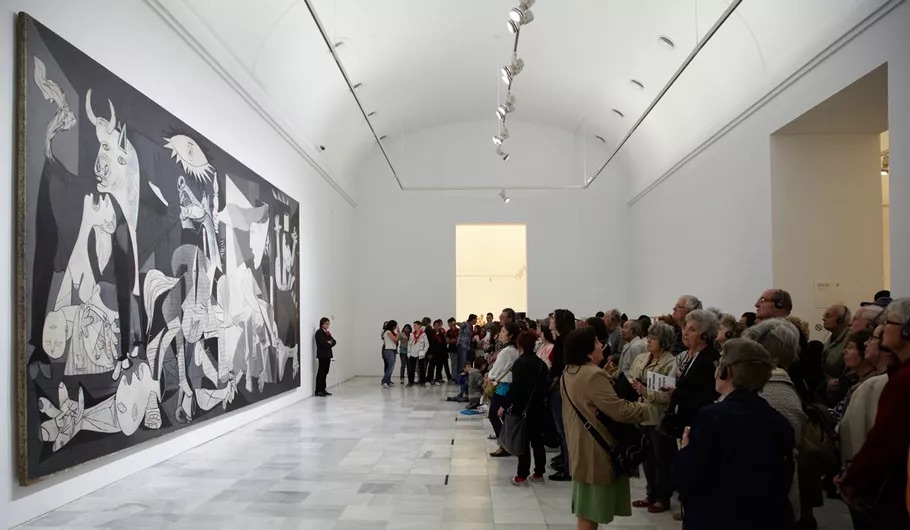
Working Title: Insights into Art’s Response to chaos threat and it’s ability to wrought social change viewed through the lens of Temporal Queer Theory: The Juxtaposition between Pablo Picasso’s Guernica (1937) and Hillary Powell’s Bank Job (2018-19)
Abstract:
This paper suggests that scaled community work engaged with the politics of public participation to reimagine art’s role in generating social change is more constructively transformative than iconoclastic ‘masterpiece’ art. That collapsing temporal notion of legacy challenges conventional visions of art’s function within society. Subverting the commodification of art and intentionally redirecting resources towards grassroots initiatives addresses issues successfully within late-stage capitalism as humanity enters the chaos of the Anthropocene.
This paper employs the theoretical framework of Temporal Queer Theory to challenge the heteronormative engagement and perception of art and to highlight art’s potential performative fluidity. Queer Temporal Theory explores how time and temporality have shaped and are being shaped by queer identities, experiences, and relationships. Grounded in the broader field of queer theory, it challenges normative understandings of time, history, and progress and seeks to disrupt linear and heteronormative notions.
This paper examines art as a medium for responding to the intersections of normative power structures and geopolitical chaos.
By temporal queering, the ethos and structure of two artistic responses to chaos threat, this research looks at the concepts of public perception versus public participation. This paper seeks to analyse how these two works embody the potency and potential of art and its ability to influence change. Examining the signifier and signified of Picasso’s Guernica alongside Hillary Powell’s intentional activism project, Bank Job.
This research explores how both works challenge traditional representations of power dynamics. By emphasising diversity, and resistance, Queer Temporal theory offers an analytic lens to view art’s effectiveness for transformation.
Iconic, multi-national and timeless, Guernica’s provocative imagery and impact on perceptions of violence and trauma contrasts Hillary Powell’s Bank Job, which offers a nuanced exploration of intentional activism art within a contemporary context.
Notes and ideas for the research paper:
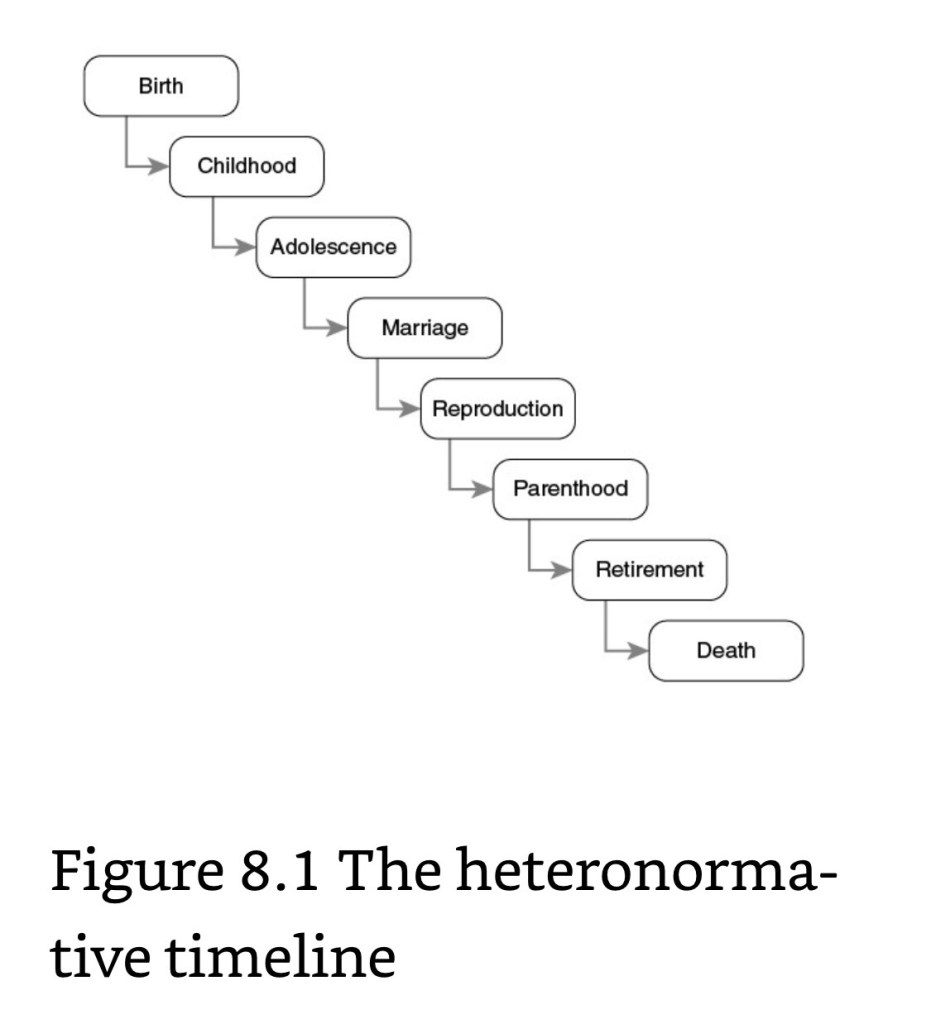
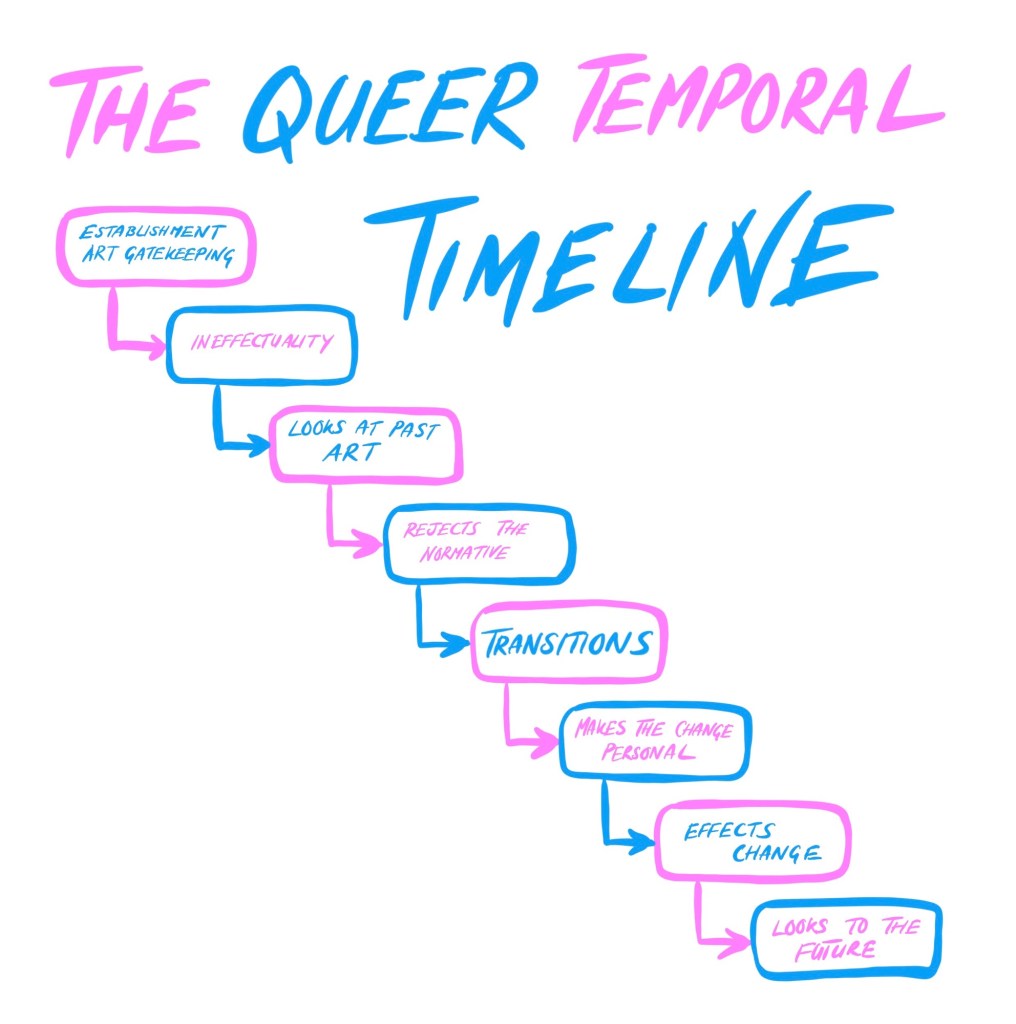

Queer Temporal Theory interrogates how society constructs and enforces temporal norms, which often privilege certain identities, bodies, and relationships while marginalising and erasing others. It recognises that time is not objective or neutral but a socially constructed framework that reflects and reinforces power dynamics and hierarchies.
Central to Queer Temporal Theory is the concept of queering time. This queering involves destabilising and subverting dominant temporal narratives and opening space for alternative temporalities and ways of being in time. Queer Temporal Theory challenges the assumption of a linear and progressive trajectory of history and instead seeks to create space for marginalised voices and disrupt oppressive power structures.
One key aspect of Queer Temporal Theory is the exploration of queer futurity. In contrast to a linear understanding of time that views the future as a destination to be reached, queer futurity emphasises the possibilities of alternative futures that challenge and transform the present.
The word chaos is borrowed from the Greek word for “abyss.”
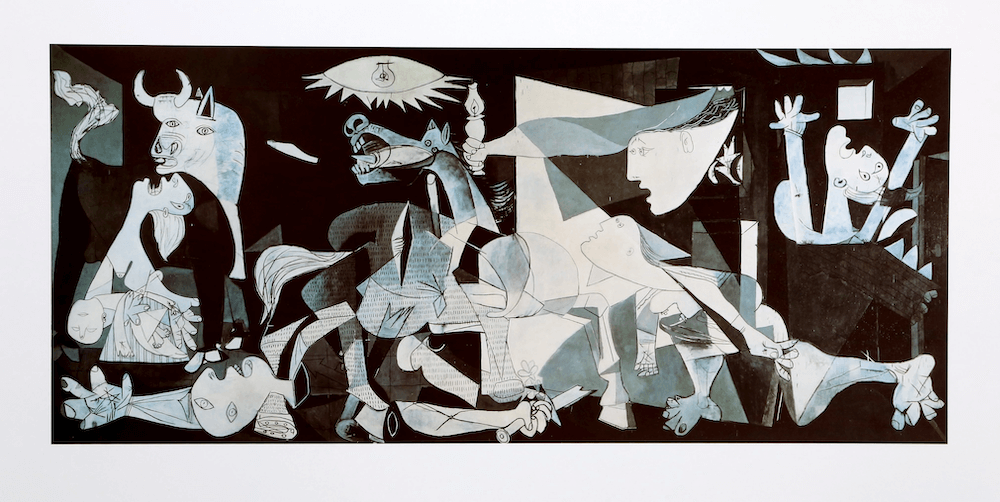
Guernica, is a vast elongated monochrome painting. It flattens and makes its characters linear. At the left of the painting is a wide-eyed bull; its tail looks like smoke lifting into the sky. The bull stands over a woman with one naked breast dangling down. Her head is thrown back in anguish, her mouth open as if she is screaming into the sky; in her arms flops a silent, lifeless young child.
The tongues of the horse, the bull, and the grieving woman are replaced by forms that look like dagger points.
Left of centre is a horse that writhes in agony, bearing a large, gaping, slashed or pierced wound on its side. The horse is patterned with a multiplicity of small vertical marks. On the floor across the painting is a dismembered body intermingled and trampled by the horse’s limbs and hooves.
The dismembered body’s head lies, eyes and mouth wide open as a corpse. The left arm reaches along the floor, and its hand bears a stigma; the severed right arm lies under the horse’s hooves and clutches a shattered sword, from which a delicate flower emerges. Above the suffering horse is a bare light bulb in the form of an all-seeing eye.
A face appears through an open doorway to the upper right of the horse. The face’s mouth is open; the face seems to have an outstretched arm carrying a lit oil lamp. Below the face, a woman staggers towards the centre; her left leg appears to be severed at the thigh and is left behind as she staggers forward, her empty gaze fixed upon the lamp.
In front of the horse’s braying mouth, a bird appears on a cracked wall; it, too, seems to be screaming.
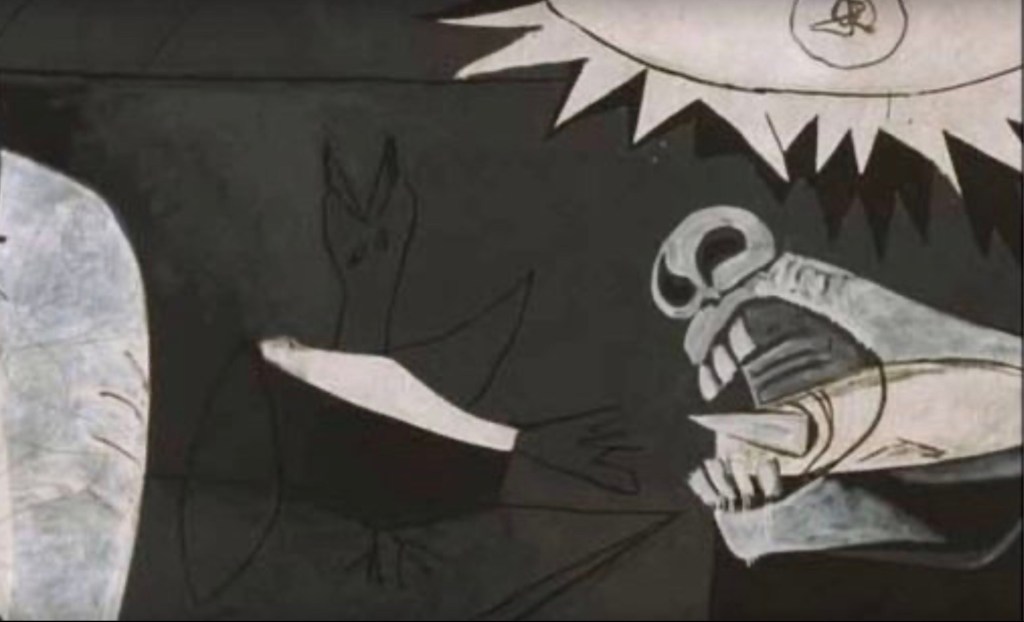
On the far right of the room, a woman raises her arms towards what looks like a small opening. Her mouth is agape, her head thrown back, as she becomes trapped in what looks like flames of fire from above and below. Her right-hand takes on the shape of an aeroplane.
The whole scene is dark and hideous and exerts a feeling of being trapped within horror.
There are many intricate hidden details within the painting, which is commensurate with Picasso’s love of semiotics, and these would have opened an immediate discussion with his contemporary audience.
(Within this paper and the lens of Queer Temporal Theory… Discussion of Picasso’s semiotics… The signifier is the sign’s physical form, in this case, a bull, representing a concept or idea of Spain or Picasso himself…The signified is the concept or idea that the signifier represents. It is the perceived meaning or concept associated with the signifier.)
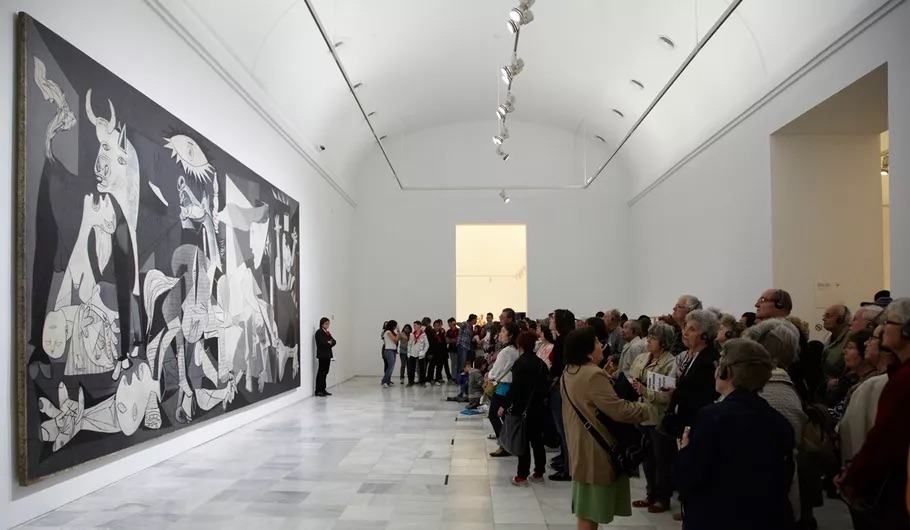
When Picasso’s Guernica was first unveiled in 1937, it was a response to the experimental bombing of the Basque town of Guernica during the Spanish Civil War by Nazi German and Italian Fascist air forces and its resulting destruction and the devastating human consequences. It had an immediate impact on the public, eliciting strong emotional responses, visceral and empathetic and sparking widespread discussions about war, violence, and the human condition. Guernica became a symbol of resistance against fascism and a rallying cry for peace and non-intervention. It questioned the ethics of warfare, the role of art in society, and the power of artistic expression as a means of social and political commentary.
The painting’s fragmented and distorted figures and monochromatic palette conveyed a sense of chaos, despair, and human suffering. Viewers were confronted with the devastating consequences of war; some found it ugly, but many were moved to reflect on the impact of violence on individuals and communities.
Guernica’s widespread public display in various locations amplified its impact. The painting toured cities in Europe and the USA, attracting large crowds and generating extensive media coverage. Its accessibility to the public allowed people from diverse backgrounds to engage with the artwork and its message.

(Was Guernica a vanity project for Picasso? It wasn’t effective as a tool to stop war. It didn’t stop WW2, Korea, Vietnam or the Gulf conflicts. Yet, it describes the horror of war perfectly. This could be Gaza as much as a small Basque town. Should art aspire to anything more than decoration or entertainment? Not known for his political activism, by 1937, he was 55 years old and already part of the system that upholds social hierarchy. The Basque Revolution impacted the ideals of capitalist production. Western powers were pursuing a policy of non-intervention. The UK, USA and other European powers fail to stop incendiary bombs from being shipped and used on a defenceless population… sounds familiar… Is Picasso Modernism’s Banksy, expressing their view on geo-political chaos without ambition to change the status quo. Is Guernica simply a vast, complex tweet by a wealthy, successful artist… or was it an artistic response to the political frustrations of a man that had been pushed beyond his comfortable safety of privilege…)
It has never been for sale and is the very definition of a priceless piece of fine art. Guernica now transcended the confines of the art world and has become a cultural phenomenon, reaching beyond traditional art audiences and becoming a touchstone for the human toll of war.
Picasso’s Guernica profoundly affected the public when it was first revealed. Its ability to evoke emotional responses and spark intellectual discussions as a symbol of resistance against war and oppression made it a seminal work in art history.
Guernica’s enduring impact continues to resonate with audiences, purportedly highlighting the power of art to provoke thought and inspire empathy. It seemingly challenges dominant narratives of acceptable collateral damage and the just war.
(war is bad… war makes lots of money though…)
Guernica’s influence extends to subsequent generations of artists, activists, and scholars who draw inspiration from immediacy and potency. It is a quintessential defining artwork. Or that’s what the challenged heteronormative power structures would have us believe. Power structures are more than governments or ideologies. They are prejudice, assumptions, colonialism, geo-political economics and established patriarchal academia.
The painting continues to be recognised as a timeless masterpiece of artistic genius and a powerful symbol of anti-war sentiment. That public reception of Guernica was not limited to its initial unveiling; its impact has endured over the decades. Guernica’s initial reception was, on closer inspection, more problematic. It fed into peace politics and non-intervention policies, particularly the fear of mass bombing.
(easy for me to go off on a bombing rabbit hole here… instead I’m collapsing time Guernica and the Middle East conflicts…)
An artwork’s image can assume life and exert power; a tapestry copy of Guernica by artists Jaqueline and René Dürrbach proved its iconic image significance. On February 5th 2003, U.S. Secretary of State Colin Powell made a speech revealing ‘evidence’ that Saddam Hussein had Weapons of Mass destruction; this was to persuade U.N. ambassadors to support a war against Iraq. Powell made a speech in the usual spot, but instead of the usual background of the Guernica tapestry, U.N. officials decided to cover it; a U.N. spokesman explained, “Tomorrow it will be covered, and we will put the Security Council flags in front of it.”
They denied that they intentionally hid the image of Guernica, but that’s not how the world’s press saw it. Did the U.N. diplomatic advisors recognise the power of art and its ability to challenge and confront political narratives?
Guernica’s covered reproduced image, with its visceral depiction of the horrors of war, was then reported by the press as a political cover-up. If Powell had been seen in front of the Guernica image, they proposed it might undermine the message of the United States and its allies in justifying military action in Iraq. Powell and his legacy were caught up in the Guernica effect. The power of war imagery, depicting the destruction, devastation and anguish of a bombed populace, was thus exploited by the press. It turned out to foreshadow the coverup of unreliable and inaccurate information about weapons of mass destruction and decades of suffering and chaos that still plays out in the Middle East today.
Powell’s Guernica experience highlights the tension between art, politics, and the potential to manipulate public perception. U.N. advisors sought to control the visual narrative and avoid any potential challenge to the legitimacy of the military intervention. This incident demonstrates the established politics of fear as much as art’s ability to subvert dominant political narratives and evoke dissenting viewpoints.
The refusal to confront the semiotics of Guernica in this context raises questions about the role of art in political decision-making. Guernica does have an enduring impact and ability to stir public consciousness. It continues as a potent symbol of resistance against the horrors of chaos and war, even in the face of attempts to silence its message.
It underscores the potential of art to challenge established power structures and disrupt the narratives put forth by those in authority. The real Guernica wasn’t on show; the more muted tapestry was covered. Still, its image was used by the press to draw attention to the painting’s provocative imagery and its capacity to challenge the justifications for war. Yet, it didn’t stop the military action.
Instead, Guernica’s conjured memory may have induced negative panic whereby society viewed the chaos of war so severe that it refused to acknowledge it and preferred to acquiesce to a narrative proposed by dominant power structures to deal with the situation. By its highly provocative nature, Guernica rendered itself impotent.

(discussion on negative panic and anxiety as a performance parameter)
In contrast to the monumental scale of Guernica, Hillary Powell’s Bank Job reimagines the role of art as a catalyst for social change and dialogue. Through innovative approaches, collective art-making, large-scale community participation, and economic critique, Powell’s project challenges conventional notions of art’s societal function and invites viewers to reflect on the intersectionality of finance, power, and social welfare.
(The participant’s body as part of the process becomes natural in collaboration, body as nature’s body… Nature into a gallery… beyond display… Viewed as a socio-political partnership… Cultivated nature into the cultural landscape.)
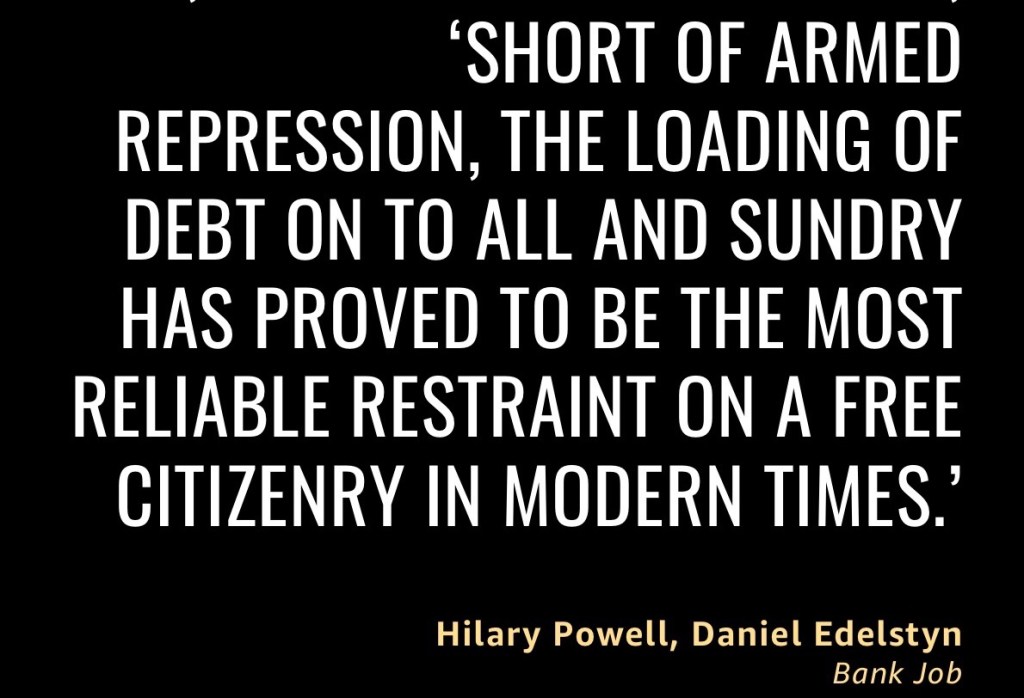
Bank Job looked at the politics of late-stage capitalism, specifically the politics and economics of debt. Ordinary people are continually marginalised and made to pay for a system they are not benefactors of. Instead, the masses assume the sacrificial identity of capitalist products and production, which causes climate chaos.
Between March 2018 and December 2019, the Bank Job collective was set up in one of the many increasingly abandoned high-street bank buildings. Using the building as a public meeting place for both installations and art events, the collective set up a local community participation project.
The Guardian called them “The Rebel Bank.”
The collective printed original banknotes and sold them as art, raising £40,000.
They used half of the proceeds to fund local projects that increasingly lack funding from the dominant narrative power structures. The collective funded food banks, marginalised youth projects and homeless kitchens. They used the other £20,000 to buy up local high-interest debt. Debts get sold for a fraction of face value because when the debtors can’t pay, they are chased for the full amount, including all the unpaid interest.
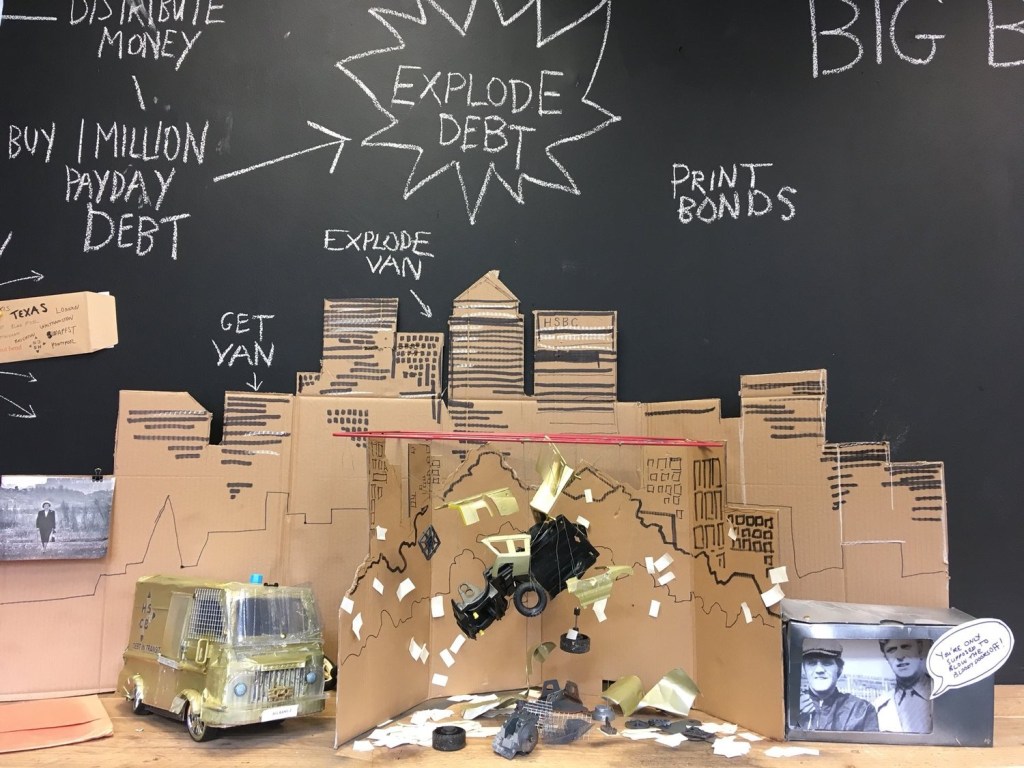
Like iconic artwork, debt becomes an investment recirculated among the rich to make them richer. In debt cases, the debtors become poorer because they are always liable for the debt. By buying up twenty thousand pounds of debt on the debt market, the Bank Job collective could effectively abolish 1.2 million of local high-interest debt.
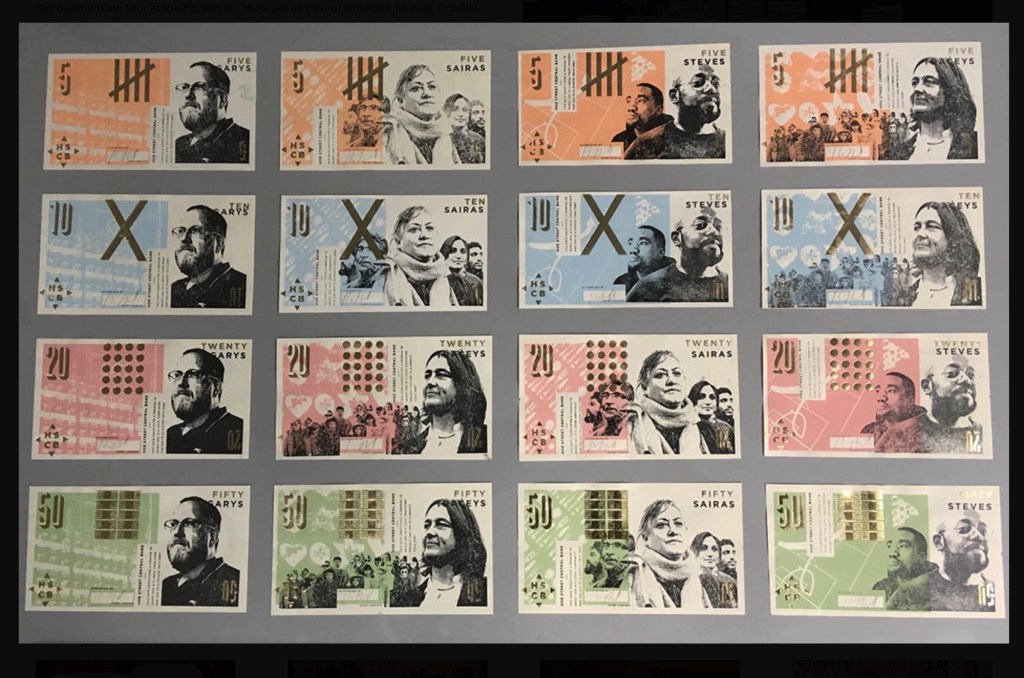
‘…became a place of intensive cultural production and debate… We printed paper bonds that funded a literal explosion of this debt…’
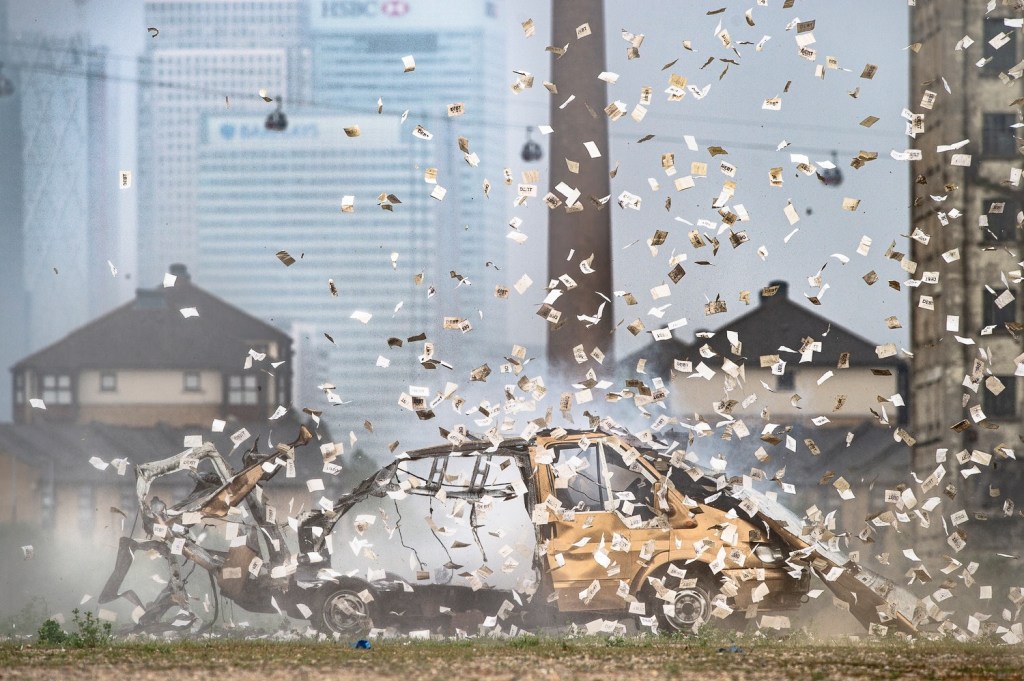
‘…blowing up a golden ‘debt in transit’ van on a docklands site with the vista of London’s financial district in the background. We proceeded to salvage and transform the van parts in to coins – souvenirs of a moment distributed to all bondholders. The van offered forth its shattered windscreen that became a one-off large-scale print Aftermath.’
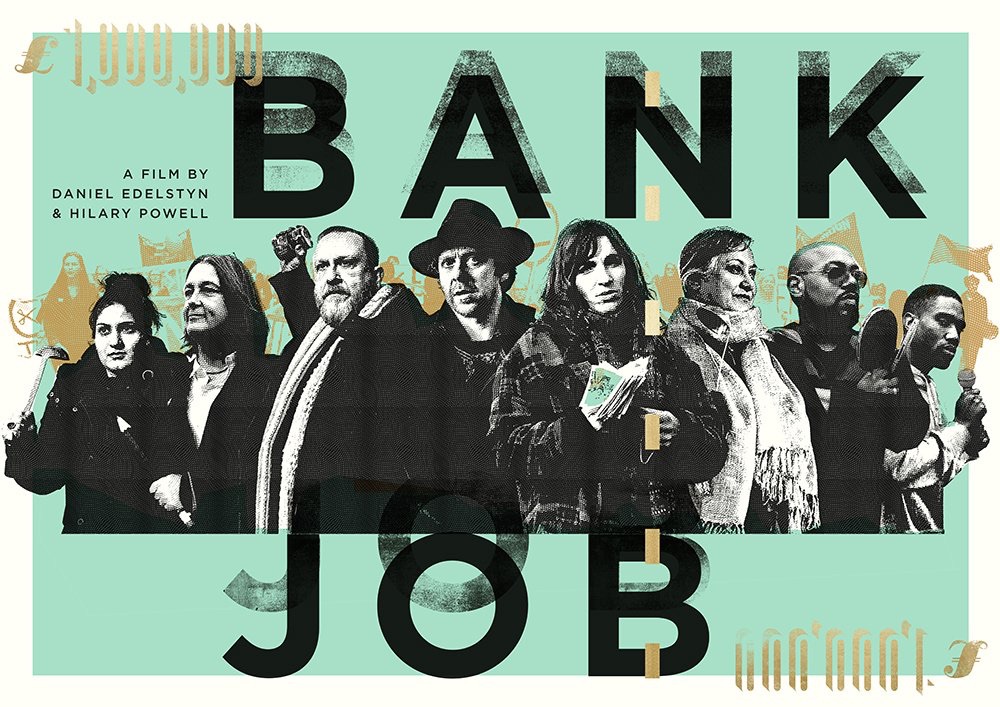
Bank Job was featured in a documentary and was nominated for:
Grierson Awards 2021
BIFA (British Independent Film Awards) Awards 2021.
Banknotes from the project are in the collections of :
Bank of England Museum,
Museum of London,
Smithsonian and Fitzwilliam Museum.
Vestry House Museum,
Victoria and Albert Museum.Smithsonian and Fitzwilliam Museum.
Prizes awarded Artquest Artweek Prize.
Jackson’s Art Prize,
Printmaking Today Prize at East London Printmaker’s Festival of Print,
Shortlisted for the Ruskin Prize: Agents of Change.
Reading List so far…
A special obscenity (2017). https://jacobin.com/2017/04/guernica-anniversary-spanish-civil-war-franco/.
Barthelmess, S. (1988) ‘Coming to grips with panic,’ Flight Safety Foundation Cabin Crew Safety, 23(2). https://flightsafety.org/ccs/ccs_mar-apr88.pdf.
Bjork, C. and Buhre, F. (2021) ‘Resisting temporal regimes, imagining just temporalities,’ Rhetoric Society Quarterly, 51(3), pp. 177–181. https://doi.org/10.1080/02773945.2021.1918503.
Bruno, G.A. (2021) ‘For the Love of Metaphysics: Nihilism and the Conflict of Reason from Kant to Rosenzweig, by Karin Nisenbaum,’ Mind, 131(522), pp. 733–742. https://doi.org/10.1093/mind/fzab026.
Bullough, O. (2018) Moneyland: Why Thieves And Crooks Now Rule The World And How To Take It Back. Profile Books.
Dieckmann, H. (1941) ‘Diderot’s conception of Genius,’ Journal of the History of Ideas, 2(2), p. 151. https://doi.org/10.2307/2707111.
Edelman, L. (2004) No Future: Queer Theory and the Death Drive. http://read.dukeupress.edu/books/book/900/No-FutureQueer-Theory-and-the-Death-Drive.
Editors of Merriam-Webster (2016) ‘Chaos: meaning and history,’ Merriam-Webster. https://www.merriam-webster.com/wordplay/chaos-meaning-and-history.
Freeman, E. (2019) ‘The Queer Temporalities ofQueer Temporalities,’ GLQ, 25(1), pp. 91–95. https://doi.org/10.1215/10642684-7275544.
Friedensen, R.E. et al. (2021) ‘Queer science: Temporality and futurity for queer students in STEM,’ Time & Society, 30(3), pp. 332–354. https://doi.org/10.1177/0961463×211008138.
Getsy, D. (2016) Queer. Documents of Contemporary Art.
Haber, B. (2019) ‘The digital ephemeral turn: queer theory, privacy, and the temporality of risk,’ Media, Culture & Society, 41(8), pp. 1069–1087. https://doi.org/10.1177/0163443719831600.
In Free Fall: A thought experiment on Vertical Perspective – Journal #24 (no date). https://www.e-flux.com/journal/24/67860/in-free-fall-a-thought-experiment-on-vertical-perspective/.
Johnson, M., Chandler, E. and Rice, C. (2024) ‘Resisting Normality with Cultural Accessibility and Slow Technology,’ Leonardo, pp. 211–216. https://doi.org/10.1162/leon_a_02502.
Kafer, A. (2008) ‘What’s Crip about queer Theory now?,’ Sex Roles, 60(3–4), pp. 291–294. https://doi.org/10.1007/s11199-008-9511-6.
Kopper, Á. (2014) ‘Why Guernica became a Globally Used Icon of Political Protest? Analysis of its Visual Rhetoric and Capacity to Link Distinct Events of Protests into a Grand Narrative,’ International Journal of Politics, Culture, and Society/an International Journal of Politics, Culture and Society, 27(4), pp. 443–457. https://doi.org/10.1007/s10767-014-9176-9.
Leach, A. (2020) ‘The rebel bank, printing its own notes and buying back people’s debts,’ The Guardian, 13 June. https://www.theguardian.com/world/2018/mar/23/hoe-street-central-bank-walthamstow-london-debt.
McCann, H. and Monaghan, W. (2019) Queer theory now: From Foundations to Futures. Bloomsbury Publishing.
McRuer, R. and Wilkerson, A.L. (2003) Desiring disability: Queer Theory Meets Disability Studies.
Moeggenberg, Z.C. and Walton, R. (2019) ‘How queer theory can inform design thinking pedagogy,’ SIGDOC ’19: Proceedings of the 37th ACM International Conference on the Design of Communication, pp. 1–9. https://doi.org/10.1145/3328020.3353924.
Ng, K. (2020) ‘Hegel’s Speculative Identity thesis,’ in Oxford University Press eBooks, pp. 65–122. https://doi.org/10.1093/oso/9780190947613.003.0003.
Peers, D., Brittain, M. and McRuer, R. (2012) ‘Crip Excess, Art, and Politics: A Conversation with Robert McRuer,’ the Review of Education/Pedagogy/Cultural Studies/Review of Education, Pedagogy, Cultural Studies, 34(3–4), pp. 148–155. https://doi.org/10.1080/10714413.2012.687284.
Powell, H. and Edelstyn, D. (2020) Bank job. Chelsea Green Publishing.
Puar, J.K. (2009) ‘Prognosis time: Towards a geopolitics of affect, debility and capacity,’ Women & Performance, 19(2), pp. 161–172. https://doi.org/10.1080/07407700903034147.
Puar, J.K. (2017) Terrorist assemblages, Duke University Press eBooks. https://doi.org/10.1215/9780822371755.
Rankin, N. (2004) Telegram from Guernica : the extraordianry life of George Steer, War correspondent. http://ci.nii.ac.jp/ncid/BA85090763.
Russell, L. (2020) Glitch Feminism : a manifesto. https://openlibrary.org/books/OL28676106M/Glitch_Feminism.
Sampson, A. (1976) The Seven Sisters: The Great Oil Companies and the World They Shaped.
Taylor, J.L. (2010) ‘Queer temporalities and the significance of ‘Music Scene’ participation in the social identities of middle-aged queers,’ Sociology, 44(5), pp. 893–907. https://doi.org/10.1177/0038038510375735.
Van Hensbergen, G. (2013) Guernica: The Biography of a Twentieth-Century Icon. A&C Black.
 Mx.D.P
Leave a comment