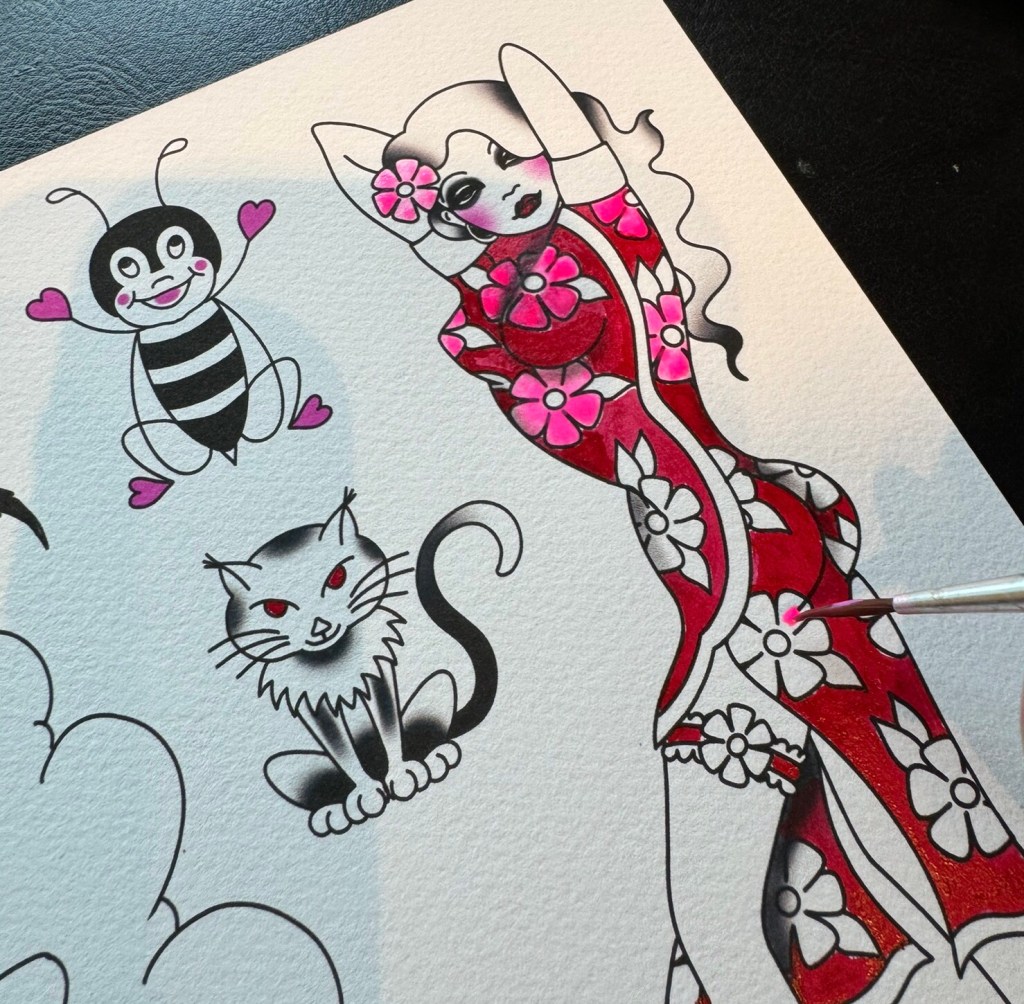
And turquoise, yellow, orange. green and a really vivid pink…
The 4000 designs live in Procreate, but others were put on paper during lockdown. Many I painted, but I found loads in a draw during the studio swap unpainted, and I thought I would finish them. It’s been a lot of work and, at times, enjoyable.
When I went to university, a long-term tattoo client asked if it would affect my tattooing, and I very stupidly said no…
Tattooing always changes. To have a long career, you must follow trends and keep up with new equipment; that’s a given. But it was fascinating to see the change in me and what I brought to the art of tattooing. I am not by any means a Trad Daddy, but I do agree with line shade and colour being the cornerstones of good tattooing. Today’s clients are not bothered about that; they want fast fashion and do not worry about longevity. That has happened before in tattooing with western tribal 25 years ago. The subsequent cover-up tattoos fed my children, and this new wave of fast fashion will feed another generation of cover-up tattoo artists and laser removers.
The designs I drew in lockdown were inspired by the last 130 years of tattooing. The oldest was from acetate stencils from the 1890’s. The faces I draw for my pin-ups are older and always inspired by Olive Oatman, who was one of the first ‘tattoo attractions’ She had her face tattooed by the indigenous tribe Tolkepayas after they killed her family and took her as one of their own in 1851. Eventually, she was released at 19 and started to earn her living on the lecture circuit.

I loved the story of Olive, but of course, like many ‘Western’ stories, it was embellished and dramatised. The truth was probably more hellish in parts. She was assimilated into the tribe and never talked ill of her captors, likely because of Stockholm syndrome. She may have found American life more problematic; she died in 1903 at the age of 65, the wife of a wealthy businessman, forced by him and society to wear a veil to cover her Indigenous tattoo.
I drew my designs in Procreate but used various methods to paint and line them. They were, in some instances, printed out as line then hand coloured.
Some were lined with a fine brush; this is the traditional method for tattoo flash sheets

I used a dip pen to line some sheets this week. I liked that; it was more unpredictable.

I was never a fan of tea and coffee staining, as the original tattoo flash became tinted because of nicotine staining. Still, as I am in experimental art mode, I tried different top washes this week. Using expresso coffee and boiled tea, I found the tea gave the most variation in colour, and the coffee had the best tone. I did a double wash of tea and coffee on some designs, and I might experiment with that more before lamination. I am laminating the sheets as they will be displayed in the tattoo area.

I started to modify the designs on the paper.

The sheets were drawn in Procreate in 2020; 4 years later, I felt constrained by their rigidity… I had changed.
 Mx.D.P
Leave a comment