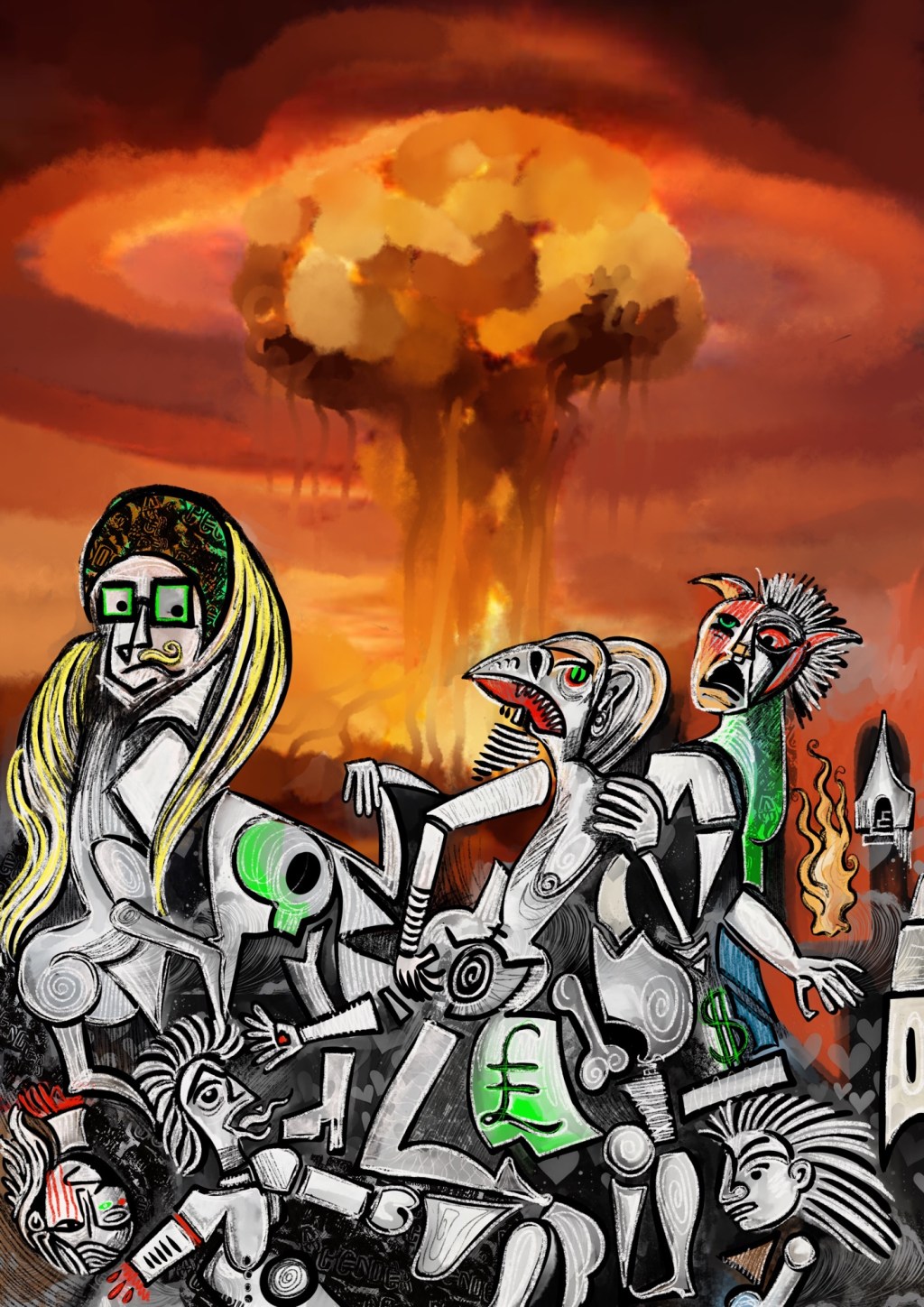
Key Words
1. Temporal Queering
2. Art Activism
3. Societal Change
4. Guernica (Picasso, 1937)
5. Bank Job (Edelstyn and Powell, 2018-19)
Abstract
This study looks at past interpretations and reactions to Guernica (1937) compared with the interdisciplinary community art activism of Bank Job (2018-19). While queering the temporal structures of perception, this comparison provides a new understanding of futurity for artists to produce a positive change. This research examines the anxiety and extreme chaos within an artwork and how it may induce a negative panic response and lead to unpredictable interpretations and reactions. This research explores how temporal queering can explain the ethos and structure of responses to chaos threat, highlighting the potential for contemporary art to drive substantial societal transformation while acknowledging its temporal limitations.
This research develops the concept of Temporal Queering to disrupt linear and heteronormative notions challenging the accepted understandings of time, history, and progress to extend situated knowledge and examine the rapidly evolving understanding of art and society. Using Temporal Queer Theory as a lens, the study challenges the heteronormative presentation and engagement of art, building on the idea of intersecting narratives to explore how contemporary artists can leverage art to offer a perspective divergent from the traditional patriarchal view.
Heteronormative power structures still inform our perception of art and its performative potential. By queering our view, we can critically challenge the societal norm. Rather than critiquing art solely within its period’s social context, this research investigates what lessons contemporary artists can gain by queering such perspectives. It aims to overturn the ideal of iconic art immortalised within oppressive power structures, opting for a positionality that enables change. This queering approach may challenge the conventional visions of art’s function within society, subverting its commodification and redirecting resources towards grassroots initiatives to address threat scenarios within late-stage capitalism within the Anthropocene.
Introduction
The key concepts and tools I have used for this study are:
Chaos theory is an interdisciplinary study of random factors affecting a scenario. The word chaos is borrowed from the Greek word for abyss. Therefore, a chaos threat is a random and unpredictable hazard in these case studies, war and socio-economic control as we enter the societal chaos of climate change. (‘CHAOS THEORY: a NEW PERSPECTIVE IN APPROACHING COMPLEX ACTIONABILITY, CULTURE, CIVILIZATION, AND CULTURAL DIVERSITY,’ 2023). Western-centric civilisations often see chaos as unfavourable, whereas other cultures, postmodern artists, and scientists often see chaos as an energising, if not unpredictable, element (Smith and Higgins, 2003).
The Anthropocene is a proposed epoch that deals with significant human impact on Earth’s ecosystems, climate and subsequent societal stability. The nature of globalisation has quickened chaos development and anxiety (Braithwaite, 2024, p. 10). At the end of the first quarter of the 21st century, we are already seeing the consequences of wealth skimming in a vain attempt to insulate the established power structures from the chaos threat posed by climate change.
Intersectionality, although first coined by Crenshaw (1998) when looking at critical race theory, has become a foundational concept in Queer theory because it provides a more nuanced understanding of how different forms of oppression interconnect. Intersectionality offers a frame to understand how multiple social identities, such as race, class, gender and sexuality, intersect at the level of individual experience and interact within broader systems of power and oppression. Recognising that overlapping identities cannot be examined in isolation from one another. Intersectionality helps understand how people respond to rapid social change and complex threat situations. These intersecting identities often expose individuals to multiple, interlocking systems of oppression and discrimination, which cannot be fully understood unless examined together. Regardless of its epoch, each society must grapple with context-specific intersecting oppressions depending on their social, cultural, and historical heritage.
Situated knowledge challenges the validity of objective, ‘detached’ knowledge associated with traditional scientific and academic practices. Instead, it suggests that all knowledge is ‘situated’ in specific contexts, including social, cultural, historical, and personal circumstances. Every knowledge producer is subject to their background, location, and the particular conditions under which knowledge is generated. No single perspective can claim total objectivity or give complete understanding. This paper is no different as it will exhibit the bias of the writer and the reader. That every perspective is partial, and multiple perspectives are needed to approach a more comprehensive understanding of a complex issue. To embrace and acknowledge bias is crucial. That knowing is an embodied process. (Haraway, 1988)
Death Drive Russian physician and psychoanalyst Sabina Sprielrein first explored the Death Drive in 1912, taken up by Freud in the 1920s. The life milestones of education, career, marriage, family, retirement and death inform the death drive. These heteronormative junctures are experienced in a linear manner that resists change and feeds late-stage capitalism. The concept was revisited by Queer theorist Edelman (2004) and set within the Queer lived experience to challenge linear experiences as queer people often experience life in a disrupted non-linear manner.
Negative Panic originally described the reactions of airline passengers to death scenarios during aircraft emergency evacuations. If a situation is so bad that death is imminent, it renders the person immobile and instead of saving themselves, they accept death (Barthelmess (1988, pp. 2, 3).
Queering is to challenge and reject the heteronormative power structures and address systems of oppression.
Queer Temporal Theory has been developed by several Queer theorists, including Edelman (2004) and Freeman (2019) and continues to be reshaped in both academic and lived experiences (Friedensen et al., 2021). Queer lives often follow different trajectories and cope with a life interrupted by bigotry and discrimination. Queer people frequently have differing life goals, creating alternative modes of experiencing life and future expectations known as Temporal Disruption. Queer Temporal Theory interrogates how society constructs and enforces temporal norms, which often privilege particular identities, bodies, and relationships while marginalising and erasing others. Its framework recognises that cultural time is not objective or neutral but a social construct that reflects and reinforces power dynamics and hierarchies.
A key aspect of Queer Temporal Theory is the exploration of queer future-time or futurity. In contrast to a linear understanding of time that views the future as a destination to be reached, queer futurity emphasises the possibilities of alternative futures that challenge and transform the present.
A Temporal Turn refers to a shift in focus or perspective towards the concept of a time point. This shift emphasises the importance of future-time as a fundamental aspect of human experience, social structures, and cultural narratives.
The Research
By using Queer temporal theory to challenge the linear, normative understanding of time and history, this study offers an alternative perspective to art that emphasises fluidity, disruption, and the coexistence of multiple temporalities. By finding non-linear narratives within accepted heteronormative historical and contemporaneous art, Queer temporalities help resist and reject linear progressions or clear beginnings and endings, echoing the complexities and fluidities of queer identities and experiences. This alternative situated knowledge and intersectionality of lived queer experience may give a different interpretation and understanding.
Guernica (1937)
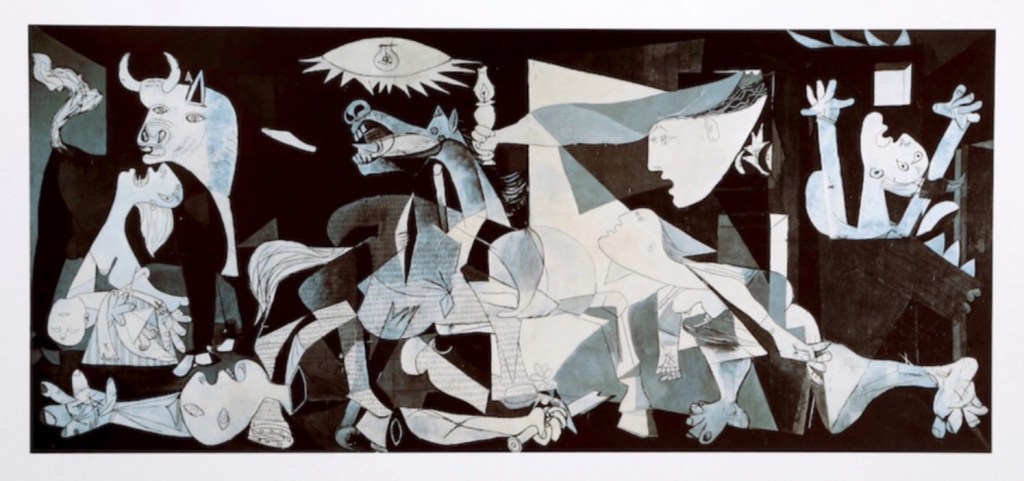
Fig. 1
Pablo Ruiz Picasso 1881 – 1973 (Spanish)
Guernica (1937)
Oil on Canvas
349.3 x 776.6 cm
Museo Reina Sofia, Madrid
Through the lens of Queer Temporal Theory, Picasso’s Guernica (1937), the painting and its legacy can be reinterpreted as a series of temporal disruptions that challenge conventional narratives and power structures.
Guernica (1937) was unveiled at the Paris Exposition in 1937; it responded to the bombing of the Basque town of Guernica during the Spanish Civil War by Nazi German and Italian Fascist air forces. The painting’s immediate impact on the public sparked a strong emotional response. It led to public discussions about war, violence, and the human condition and evolved into a complex temporal disruption. Guernica (1937) quickly became both a symbol of resistance against fascism and a rallying cry for peace and non-intervention groups, questioning the ethics of warfare, the role of art in society, and the power of artistic expression as a means of social and political commentary.
The painting’s fragmented and distorted figures and monochromatic palette conveyed a sense of chaos, despair, and human suffering (fig.1). These elements disrupt linear narratives by presenting a visual, non-cohesive, multi-layered depiction of the horrors of war. The intricate hidden details within the painting, reflecting Picasso’s love of semiotics, would have been more readily understood by audiences of its epoch, especially in Europe. Nonetheless, the imagery of the mutilated soldier, dead child, and a woman fleeing from a burning building remains relevant across different temporal contexts, from the Spanish Civil War to contemporary conflicts in Gaza and Ukraine. Therefore, Guernica (1937) has queered time and has already challenged the linear progression, perception and expectation, enabling diverse viewpoints to destabilise and subvert dominant temporal narratives and opening space for alternative temporalities and understanding. Guernica (1937) was a visceral response by an established artist to a chaos threat. These destructive feelings are recognised and seen by others to evoke feelings of anxiety, conflict, and uncertainty and, once spun, can feed into the heteronormative oppressive power structures as discussed in the paper aptly titled Publicizing atrocity and legitimizing outrage: Picasso’s Guernica, Xifra and Heath (2018)
In its epoch, Guernica’s (1937) temporal disturbance was amplified by its widespread public display. After the close of the Paris Exposition, Guernica (1937) travelled on display to Oslo, Stockholm and Copenhagen in 1938 before returning to France. In March 1939, Franco’s Fascists came to power in Spain and Guernica (1937) was sent to America to raise funds and support for Spanish refugees. Picasso asked the Museum of Modern Art (MOMA) in New York to oversee the work. Between 1939 and 1952, Guernica travelled across the United States. The painting’s mobility in location and socio-economic reception before and during World War Two was felt throughout non-Nazi Europe and the USA, attracting large crowds and generating extensive media coverage. It may have fed into anti-war sentiment and appeasement policies of America in the late 1930s by triggering a negative panic response to chaos threat. After America entered the war, its image was ‘re-spun’ to feed into patriotic anger and the Death Drive. The painting continued to tour for decades, its temporal journey transcending its initial historical context. As the Cold War brewed, Guernica (1937) travelled throughout the 1950s to Brazil and Europe and then back to MOMA for Picasso’s 75th birthday. Guernica (1937) didn’t return to Spain until 1981, when Spain was free of fascism, eight years after the artist’s death. It’s difficult to imagine a work of art having that much physical reach these days, engaging people from diverse backgrounds and time periods. Just like a Taylor Swift tour (contemporary temporal context), Guernica (1937) in exhibition becomes the place to be. This continued exposure means that Guernica (1937) is no longer a product of its age but queers time in a way that many traditional touring artworks don’t achieve today.
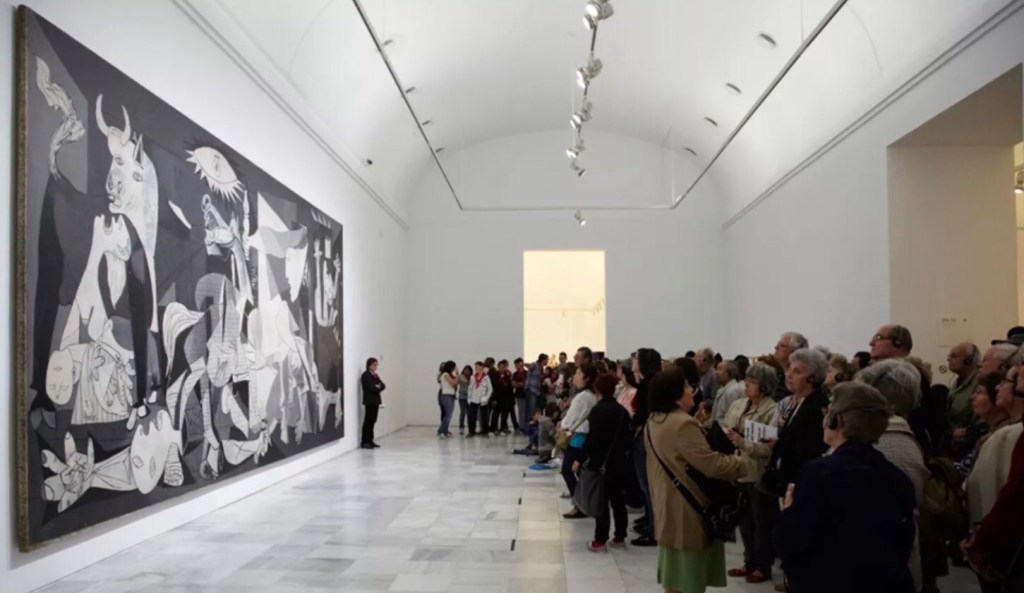
Fig. 2, Installation view of Picasso’s Guernica (1937). Photo by Joaquín Cortés / Román Lores. Courtesy of Museo Nacional Centro de Arte Reina Sofía.
Audiences still flock to see Guernica (1937)(fig. 2), and it remains a powerful, shocking experience as it feeds into the anxiety of the heteronormative Death Drive. The concept of anxiety within a performance parameter (negative panic) has long been accepted. In Guernica’s (1937) case, negative panic proposes that if art is too antagonistic, it may render its message impotent or stun its audience into accepting existing oppressive power structures as an avoidance strategy. Guernica (1937) does initiate an extreme emotional response, raising the possibility that Guernica (1937) triggers an excessive level of anxiety, which contributes to its complex reception.
By queering Picasso’s legacy, the notion of a singular, fixed intention behind the artwork becomes mute. Instead, we acknowledge the multiplicity of interpretations and the fluidity of meaning that emerges over time. Guernica’s (1937) role as a symbol of resistance against fascism, its influence on peace politics and non-intervention policies, and its impact on public perceptions highlight the unpredictable chain of events that art can set in motion. Guernica’s (1937) influence has extended to subsequent generations of artists, activists, and academics who draw inspiration from its immediacy and potency. It continues to feed into geopolitics, particularly the fear of mass bombing of civilian populations.
An artwork’s image can assume life and exert power without the physical presence of the original work. In 1984, a tapestry copy was displayed as a permanent loan in the United Nations in New York. Even a copy of Guernica (1937) provides leveraging influence. In 2003, U.S. Secretary of State Colin Powell delivered a speech presenting ‘evidence’ of Saddam Hussein’s Weapons of Mass Destruction to persuade U.N. ambassadors to support a war against Iraq. The decision to cover the tapestry during Powell’s speech can be seen as an attempt to suppress a temporal conflagration between past anti-war sentiments and Powell’s then-political agenda. The press reported this act of hiding the tapestry as a political cover-up, highlighting the tension between art, politics, and the intersectionality of manipulating public perception.
The incident demonstrates the established politics of fear within chaos theory and art’s ability to subvert dominant political narratives and evoke dissenting viewpoints. The refusal to confront Guernica (1937) and its semiotics raises questions about the role of art in political decision-making. By viewing Guernica (1937) through the lens of queer temporal theory, we recognise the fluidity and multiplicity of time, where past and present intermingle to challenge conventional narratives. Guernica (1937) taking a temporal turn is essential to understanding social justice within art and society.
‘… temporal rhythms that shape rhetorical actions and collectively argues that attending to these covert temporalities is essential to the larger rhetorical project of resisting oppression and reorienting our communities toward justice.’ (Bjork and Buhre, 2021)
Power structures are more than governments, ideologies and established patriarchal academia; they are prejudice, assumptions, and colonialism to suppress the poor, global majorities and control geo-political economics. Guernica’s (1937) potential to feed into negative panic means it is a trope used and misused throughout its temporal life. It underscores the limitations of art as a tool for constructive political change. Guernica (1937) has a provocative nature, and its conjured anxiety-fuelled memory may induce a societal response that prefers to acquiesce to dominant power structural narratives (Qi, no date). In this way, Guernica (1937) renders itself both potent and impotent, continually challenging and challenged by the temporal dynamics it inhabits; it becomes unstable as an agent of change.
Bank Job (2018-19)
Dan Edelstyn and Hilary Powell’s Bank Job (2018-19) is a multi-media artwork: community printing project, film, limited edition prints and book. Bank Job (2018-19), however, is much more; it offers a radical reimagining of the role of art as an active catalyst for social and fiscal change and dialogue. Unlike Picasso’s Guernica (1937), which leaves the power of art in the hands of interpretation and manipulation, Bank Job queers the very concept of what it means to create and engage with art, challenging the traditional parameters of where, when, and how art should exist.
Bank Job (2018-19) represents a socio-political, pro-active partnership that transforms a blighted social landscape into a lived cultural production. By setting up in an abandoned high-street bank between March 2018 and December 2019, the Bank Job Collective disrupted the temporal and spatial norms of art production. The building became a public meeting place for installations and art events, fostering local community participation and queering the conventional understanding of an art space.
By printing and selling banknotes as art in an old bank building, ironically named by Edelstyn and Powell as the Hoe Street Central Bank (HSCB) in Walthamstow, the collective raised £40,000. The banknotes feature the faces of local community workers who operate food banks, youth projects and schools. Of various note values, they were sold at their ‘face’ value. If a banknote had a five printed on it, it was sold for £5. The local community projects that provided the visual inspiration were now funded by half the profits from the print sales. The banknotes funded the food banks, marginalised youth projects, and homeless kitchens that are often neglected by dominant heteronormative patriarchal power structures. The other £20,000 was used to buy up local high-interest debt, cheaply traded on the secondary high-interest debt market, which, if paid off by the debtors, would have cost them £1.2 million.
In queer temporal terms, Bank Job (2018-19) revolves around the concept of debt, focusing on payday loans, which often carry exorbitant interest rates, reflecting the artist’s commitment to addressing systemic inequality through innovative contemporary art. Community engagement in producing and selling art prints as an alternative currency in a former bank became a protest against predatory lending practices in the payday loan high-interest markets. Still, crucially, it also deals with the emotionally and fiscally destructive fallout from such practices that marks the heteronormative death drive and late-stage capitalism greed for consumption that has brought us to the brink of climate chaos. The physical act of dividing the profits from the print sales to support local community organisations can also be seen as an act of artistic resistance. Using the other half of the profits to buy payday loan debt is a tangible example of how monetary yield can be spread around. It queers the concept of capitalist production models and snubs the shady practice of financial institutions reselling payday loans at knockoff prices to greedy speculative investors.
Typically, the main purchasers of payday loan debts are collection agencies. These companies profit from the trade by hounding individual debtors to recover more money than the price they paid on the secondary debt markets. The primary debt market is the original bank or company that loans the money to those in dire need at ridiculous interest rates. Payday loan borrowers wouldn’t be normally granted a low-interest bank loan and often have no or very little collateral and a meagre income. Once these debts are sold to the secondary markets, the loans frequently default and reach monstrous life-changing proportions. Borrowers who default on loans do so because they are already in a financial position where they cannot pay their existing day-to-day bills; that’s why they need the loan in the first place. They don’t pay because they want to default on their loan but because they face genuine hardship. High-interest loans become a ‘Gateway’ to exploit vulnerable individuals (Magli et al., 2024). The aggressive tactics employed by the secondary market debt collection agencies increase the humiliating and precarious situations debtors face. They become trapped in a system that propagates financial servitude and props up the heteronormative patriarchal power structures.
When you examine the high-interest debt market, the global majority shows up in the data (Hanson et al., 2014, p. 14). Bank Job (2018-19) reaches deeper into the social colonialist nature of the politics and economics of debt. This artwork critiques late-stage capitalism’s manipulation of the production workforce; many comprise communities representing peoples of the global majority.
The global majority are not white and do not have the privilege of resources and political power, but today, they are on the frontline of geo-political chaos and poverty.

Fig. 3 Big Bang 2 (2019) part of Bank Job (2018-19), Photo: Graeme Truby-Suerty. (Big Bang 2 Explosion Art Print Ltd Edition of 100 — BANK JOB, no date)
The Bank Job (2018-19) film used iconic imagery inspired by (The Italian Job [Film], 1969). This homage not only blows the ‘bloody doors’ off high-interest debt (fig. 3) but employs humour to engage the audience in the dull nuances of the secondary debt market and the collective potential to resist debt. Using humour also reduces anxiety (Padhy et al., 2024) and, therefore, the risk of developing negative panic. The blowing up of the debt van in the shadow of London’s financial district is called Big Bang 2 (Powell and Edelstyn, 2020, p. 4); it is a performative act and becomes a film and a limited-edition print. ‘Big Bang’ refers to the economic reforms initiated during Margaret Thatcher’s era (Robertson, 2016). It shows the deliberate temporal queering of Bank Job (2018-19) as a critical response to the historical consequences of those reforms, challenging the status quo and reimagining the landscape of financial accountability.
The provocative question raised by Bank Job (2018-19) is if banks can have their debts cancelled as they did in the financial crisis of 2008, why can’t ordinary borrowers do the same in times of need? This artistic question begins to examine the existing power structures and the temporality of debt. It might be easy to assume this is just a cosy community art project and that none of this make-believe print money is real. Still, the frightening reality is that very little of any banking system money are physical assets and is almost entirely built on the process of loans.
The Bank of England clearly states,
‘Whenever a bank makes a loan, it simultaneously creates a matching deposit in the borrower’s bank account, thereby creating new money.’ (McLeay et al., 2014, p. 14)
The experience of falling into debt commodifies an individual’s financial struggles and funds the banks. The banks then trade these defaulted debts as commodities like orange juice or oil. The Bank of England reports that 79% of money exists digitally as loans, not assets or physical currency. (McLeay et al., 2014; How is money created?, no date)
A considerable proportion of world ‘money’ is an electronically written debt on a computer system. Montgomerie (2019) explores the possibility that household debt could be cancelled without adversely impacting the economy. This freedom from debt would release the debt slaves and cancel the income for those dealing in the secondary market. It would effectively end the grip of late-stage capitalism.
Bank Job (2018-19) was launched pre Covid-19. During the pandemic, payday loans sometimes became the only funding source for those who fall between the benefits–working poor gap (Ulster University, 2021, p. 4). The legacy of Bank Job (2018-19) gains particular significance against the backdrop of the economic upheaval during those times. The subsequent derailing of the economy post-pandemic by warring Conservative factions within the government exacerbated the worsening situation. Today, the Financial Services Authority (FSA) has tried to stop the worse excesses of payday loans. However, it has unfortunately caused more suffering as many people have to go to loan sharks, unable to access payday loans (Meganfoster, 2022).
Edelstyn and Powell could not have predicted any of this. So, as with Guernica (1937), a work of art is subjected to a temporal disturbance that the artist can’t control. As much as Bank Job (2018-19) subverts traditional banking aesthetics and practices through its establishment of a printing press, producing banknotes that celebrate community resilience and resistance to the heteronormative patriarchy, the purchase of £20,000 of high-interest debt from the secondary market is the most intriguing aspect in queer temporal terms. With Bank Job (2018-19), art has intervened in the capitalist process of commodifying financial distress and chaos. The abolishing of £1.2 million in local debt is an act of economic resistance that queers the relationship between art, money, and social justice, turning debt, which often serves to marginalise and impoverish, into community empowerment. To the individuals and community projects that interacted with Bank Job (2018-19), it made a tangible change to their immediate lives and possible futurity outcomes.
Bank Job (2018-19) couldn’t knowingly respond to a future pandemic or a government neglectfully crashing the economy, but it does understand the shifting sands of finance. Bank Job (2018-19) advocates for a model of sovereign money creation, where the government could issue debt-free, interest-free currency to end the reliance on profit-driven money systems. Bank Job (2018-19) also highlights the low prices at which debts are routinely traded. Edelstyn and Powell not only queered traditional financial narratives but also transformed the act of currency creation into a form of artistic expression and resistance. Bank Job (2018-19) was acquired by the Victoria and Albert Museum and the Bank of England Museum. Even this patriarchal art-washing acquisition invites discourse and action within the framework of debt resistance and financial reform, reshaping temporal narratives and physically queering the temporality of debt repayment.
Conclusion
In the early 21st century, Bank Job (2018-19) demonstrates that for art to be truly transformative, its power must be recognised and carefully guided. Contemporary art’s obsession with didactic avoidance, allowing audiences to draw their own conclusions, can be alluring conceptually and financially as ambiguity is easier to sell, but it is also potentially precarious. Bank Job challenges this by offering a proactive, transactional experience that directly engages with societal issues, rather than Guernica’s (1937) example of consuming the emissions of iconoclastic art within heteronormative power structures. Both Guernica (1937) and Bank Job (2018-19) queer establishment power structures, but they do so in fundamentally different ways. Guernica’s (1937) audience, at best, views and reacts to the artwork or, at worst, consumes it as an art experience; either way, the audience is potentially subjected to anxiety-provoking negative panic responses. Therefore, Guernica (1937) relies on the power of interpretation and opens the potential for manipulation, leaving its impact largely in the hands of heteronormative power structures. In contrast, Bank Job (2018-19) offers a more positive futurity outcome by queering society’s interactions with art through lived, transactional experiences. Edelstyn and Powell’s approach challenges and actively disrupts the dominant narratives, offering a tangible, community-focused alternative to the consumption of traditional art. By reframing art as an active, lived experience that directly engages with and transforms societal issues, Bank Job (2018-19) queers the temporal and spatial boundaries of art, offering a new model for how art can function as an agent of change within its immediate epoch. Art, however carefully crafted, is still subjected to the unknown, as with Bank Job’s (2018-19) meeting with Covid-19 and the FSA, artists can never predict their art’s temporal turn.
All art, in time, may become unstable as an agent of change, which might be its true chaotic power.
Bibliography
Admin (2021) Picasso’s Guernica. https://artanddesign101.com/picassos-guernica/.
Barthelmess, S. (1988) ‘Coming to grips with panic,’ Flight Safety Foundation Cabin Crew Safety, 23(2). https://flightsafety.org/ccs/ccs_mar-apr88.pdf.
Big Bang 2 Explosion Art Print Ltd Edition of 100 — BANK JOB (no date). https://bankjob.pictures/new-products/big-bang-2-explosion-art-print-ltd-edition-of-100.
Bjork, C. and Buhre, F. (2021) ‘Resisting temporal regimes, imagining just temporalities,’ Rhetoric Society Quarterly, 51(3), pp. 177–181. https://doi.org/10.1080/02773945.2021.1918503.
Braithwaite, J. (2024) Simple solutions to complex catastrophes: Dialectics of Peace, Climate, Finance, and Health. Springer Nature.
‘CHAOS THEORY: a NEW PERSPECTIVE IN APPROACHING COMPLEX ACTIONABILITY, CULTURE, CIVILIZATION, AND CULTURAL DIVERSITY’ (2023) International Journal of Multiculturalism [Preprint]. https://doi.org/10.30546/2523-4331.2023.4.2.34.
Crenshaw, K. (1998) ‘Demarginalizing the intersection of race and sex: A Black Feminist critique of antidiscrimination doctrine, feminist theory, and antiracist politics,’ in Oxford University Press eBooks, pp. 314–343. https://doi.org/10.1093/oso/9780198782063.003.0016.
Edelman, L. (2004) No Future: Queer Theory and the Death Drive. http://read.dukeupress.edu/books/book/900/No-FutureQueer-Theory-and-the-Death-Drive.
Financing Prosperity by Dealing with Debt (2022) UCL Press eBooks. https://doi.org/10.14324/111.9781800081871.
Freeman, E. (2019) ‘The Queer Temporalities of Queer Temporalities,’ GLQ, 25(1), pp. 91–95. https://doi.org/10.1215/10642684-7275544.
Friedensen, R.E. et al. (2021) ‘Queer science: Temporality and futurity for queer students in STEM,’ Time & Society, 30(3), pp. 332–354. https://doi.org/10.1177/0961463×211008138.
Hanson, T. et al. (2014) Research into the payday lending market, TNS BMRB, p. 2. https://assets.publishing.service.gov.uk/media/5329df8aed915d0e5d000339/140131_payday_lending_tns_survey_report_.pdf.
Haraway, D. (1988) ‘Situated Knowledges: the science question in feminism and the privilege of partial perspective,’ Feminist Studies, 14(3), p. 575. https://doi.org/10.2307/3178066.
How is money created? (no date). https://www.bankofengland.co.uk/explainers/how-is-money-created.
Magli, E. et al. (2024) ‘Exploring ‘Alternatives’ in the consumer credit market: community development finance institutions in the United Kingdom,’ Tijdschrift Voor Economische En Sociale Geografie [Preprint]. https://doi.org/10.1111/tesg.12640.
McLeay, M. et al. (2014) Money creation in the modern economy, Quarterly Bulletin. journal-article. https://www.bankofengland.co.uk/-/media/boe/files/quarterly-bulletin/2014/money-creation-in-the-modern-economy.pdf.
Meganfoster (2022) Unintended consequences: Why Payday Loans matter in the Cost-of-Living Crisis – CURB. https://blogs.coventry.ac.uk/researchblog/unintended-consequences-why-payday-loans-matter-in-the-cost-of-living-crisis/.
Montgomerie, J. (2019) Should we abolish household debts? John Wiley & Sons.
Museo Nacional Centro de Arte Reina Sofía (no date) Pablo Picasso (Pablo Ruiz Picasso) – Guernica. https://www.museoreinasofia.es/en/collection/artwork/guernica.
Padhy, M. et al. (2024) ‘Humour as a moderator between hassles and Well-Being,’ Psychological Studies [Preprint]. https://doi.org/10.1007/s12646-024-00795-1.
Powell, H. and Edelstyn, D. (2020) Bank job. Chelsea Green Publishing.
Qi, B. (no date) ‘ON THE EXPRESSION AND GUIDANCE OF NETWORK EMOTION IN EMERGENCIES FROM THE CHANGE OF EMOTIONAL BEHAVIOR — TAKING THE RAINSTORM IN ZHENGZHOU ON JULY 20 AS AN EXAMPLE,’ The International Journal of Neuropsychopharmacology, 25(Supplement_1), pp. A37–A38. https://doi.org/10.1093/ijnp/pyac032.052.
Robertson, J. (2016) How the Big Bang changed the City of London for ever. https://www.bbc.co.uk/news/business-37751599.
Smith, W. and Higgins, M. (2003) ‘Postmodernism and Popularisation: The Cultural Life of Chaos Theory,’ Culture and Organization, 9(2), pp. 93–104. https://doi.org/10.1080/14759550302803.
The Italian Job [Film] (1969). Paramount Pictures.
Ulster University (2021) The impact of Covid-19 and associated lockdown on financial difficulties, debt and illegal money lending. https://www.consumercouncil.org.uk/sites/default/files/2023-10/Impact_of_COVID_Illegal_Money_Lending.pdf.
Van Hensbergen, G. (2013) Guernica: The Biography of a Twentieth-Century Icon. A&C Black.
Xifra, J. and Heath, R.L. (2018) ‘Publicizing atrocity and legitimizing outrage: Picasso’s Guernica,’ Public Relations Review, 44(1), pp. 28–36. https://doi.org/10.1016/j.pubrev.2017.10.006.
List of Illustrations
Fig. 1, Pablo Ruiz Picasso 1881 – 1973 (Spanish) Guernica (1937) Oil on Canvas 349.3 x 776.6 cm Museo Reina Sofia, Madrid (Museo Nacional Centro de Arte Reina Sofía, no date).
Fig. 2, Installation view of Picasso’s Guernica (1937). Photo by Joaquín Cortés / Román Lores. Courtesy of Museo Nacional Centro de Arte Reina Sofía (Admin, 2021).
Fig. 3, Big Bang 2 becomes an art print (Big Bang 2 Explosion Art Print Ltd Edition of 100 — BANK JOB, no date). Photo: Graeme Truby-Suerty.
The author of this paper has been assisted by the following:
Grammarly
Scribbr
Word Count (excluding Captions, Abstract, Key Words, Bibliography and List of Illustrations) – 3937
 Mx.D.P
Leave a comment