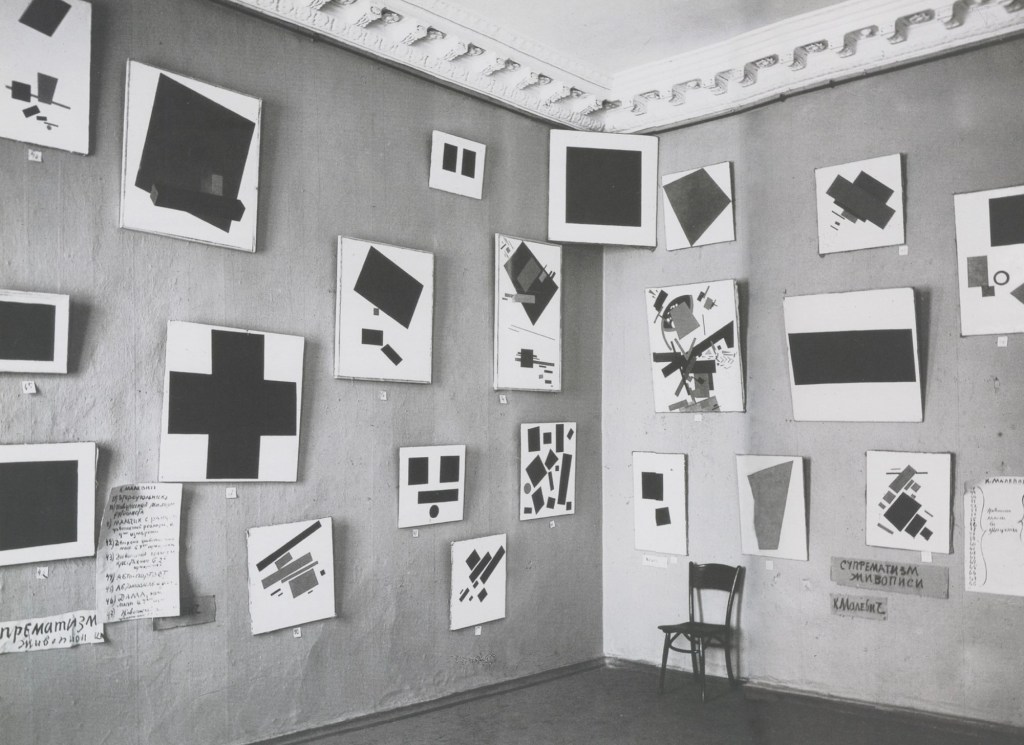
0,10 Exhibition, 1915.
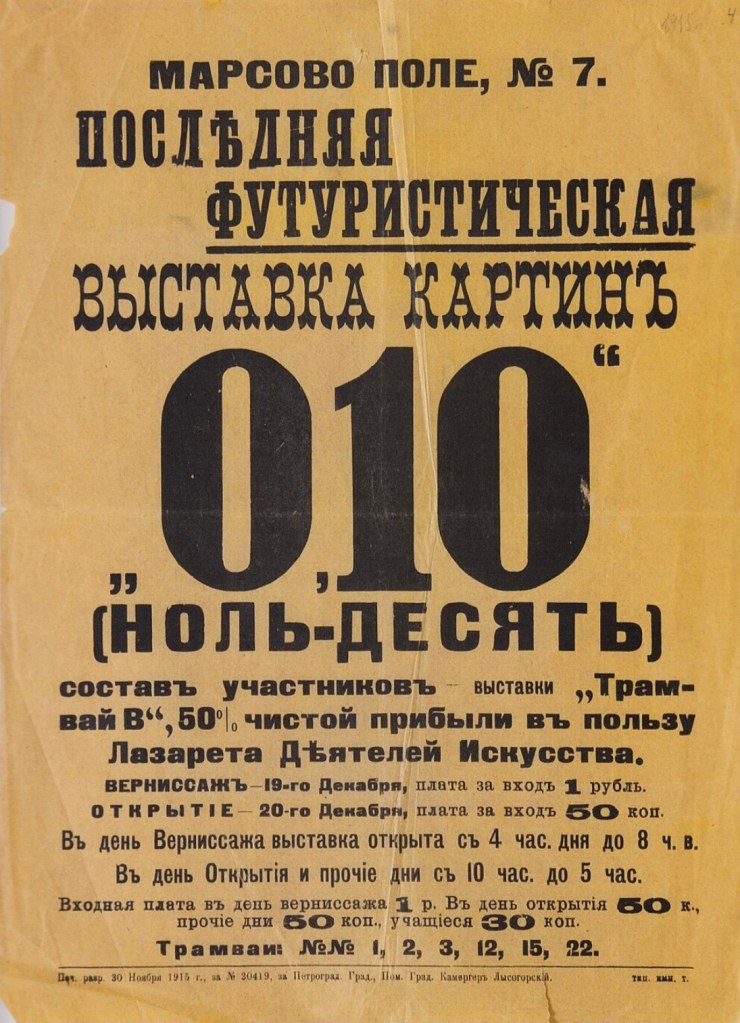
50:00 Is it Pink? It is partly inspired by the 1915 exhibition, ‘The Last Futurist Exhibition of Paintings 0,10’ (pronounced ‘zero-ten’). It was held at Marsovo Pole, Petrograd, from December 19, 1915, to January 17, 1916. Organised by the Dobychina Art Bureau, this exhibition marked the debut of Suprematism, an art movement characterised by geometric abstraction and vibrant colours. It also signified the end of Cubo-Futurism, Russia’s leading avant-garde movement at the time.
The enigmatic title ‘0,10’ symbolised both destruction and rebirth. ‘Zero’ represented the start of a new era in art after dismantling traditional norms, while ‘Ten’ referred to the initially planned number of collaborating artists, though fourteen ultimately contributed. The exhibition’s organiser, Ivan Puni, coined its non-numerical name to emphasise its Futurist roots.
In 1915, Puni organised Tramway V, Russia’s first all-Futurist exhibition. Despite its controversial reception, it set the stage for 0,10, bringing together artists like Kazimir Malevich and Vladimir Tatlin. Malevich was deeply immersed in developing Suprematism during this period, aiming to transcend Cubo-Futurism through pure abstraction.
The exhibition showcased 155 works, including Malevich’s iconic Black Square, Tatlin’s Corner Counter Reliefs, and Olga Rozanova’s Metronome. Malevich unveiled thirty-nine Suprematist pieces, positioning Black Square in a corner traditionally reserved for religious icons, a deeply controversial statement at the time. Tatlin’s sculptures defied conventional art forms by suspending objects in space, while Rozanova’s Metronome explored themes of time and infinity.
Malevich and Tatlin’s rivalry influenced the exhibition’s dynamics. Malevich’s strategic room arrangement ensured his dominance over Tatlin’s neo-Constructivist works.
Despite limited surviving documentation, 0,10 is a transformative moment in modern art history.
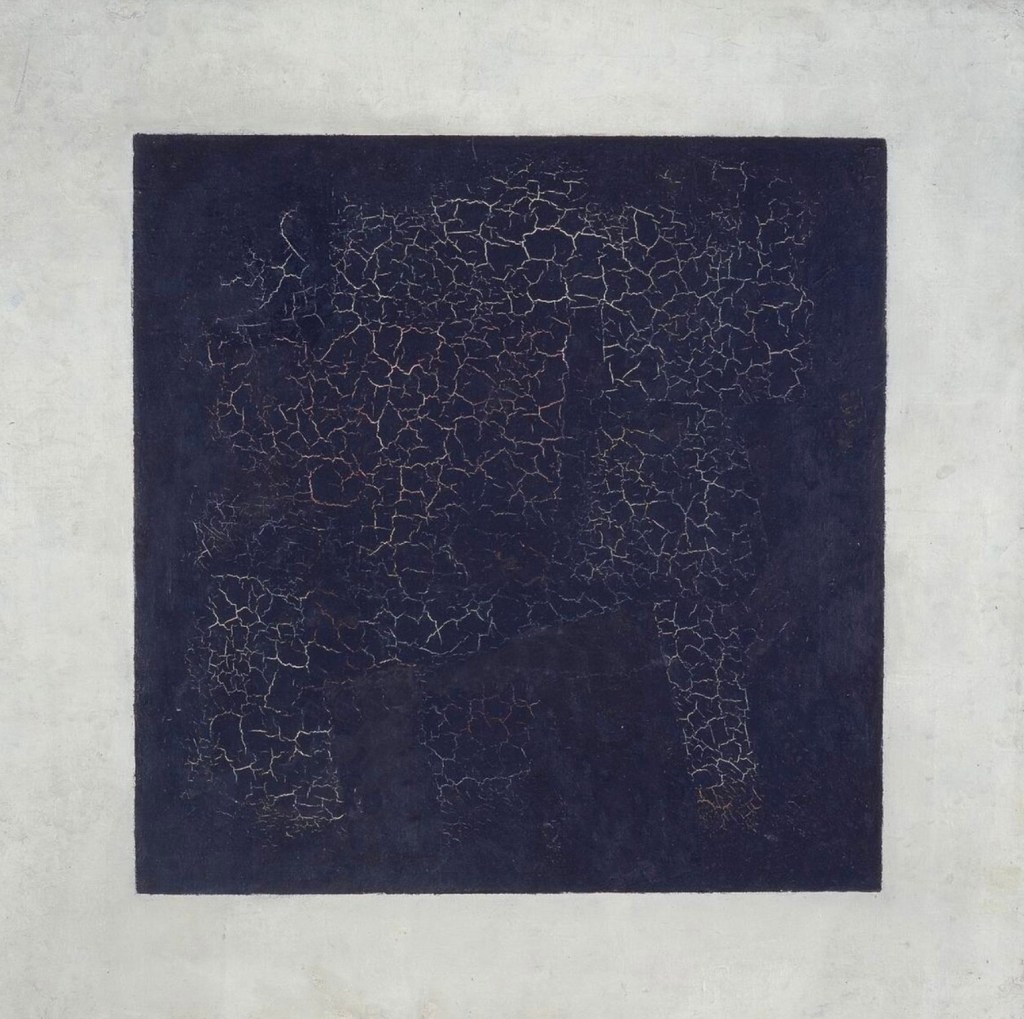
Kazimir Malevich 1879 – 1935, Russian.
Oil on linen canvas, 79.5 x 79.5 cm, Tretyakov Gallery, Moscow
My use of it as inspiration is an alpha/omega moment of the Earth’s destruction. It suggests a possible alternative future of a global network of creative kindness. Asking an ironic cheeky queer temporal question of ‘Is it Pink?’
 Mx.D.P
Leave a comment