
A social media art practice? Is there such a thing? Well, there is one if you are trying to make a global network!
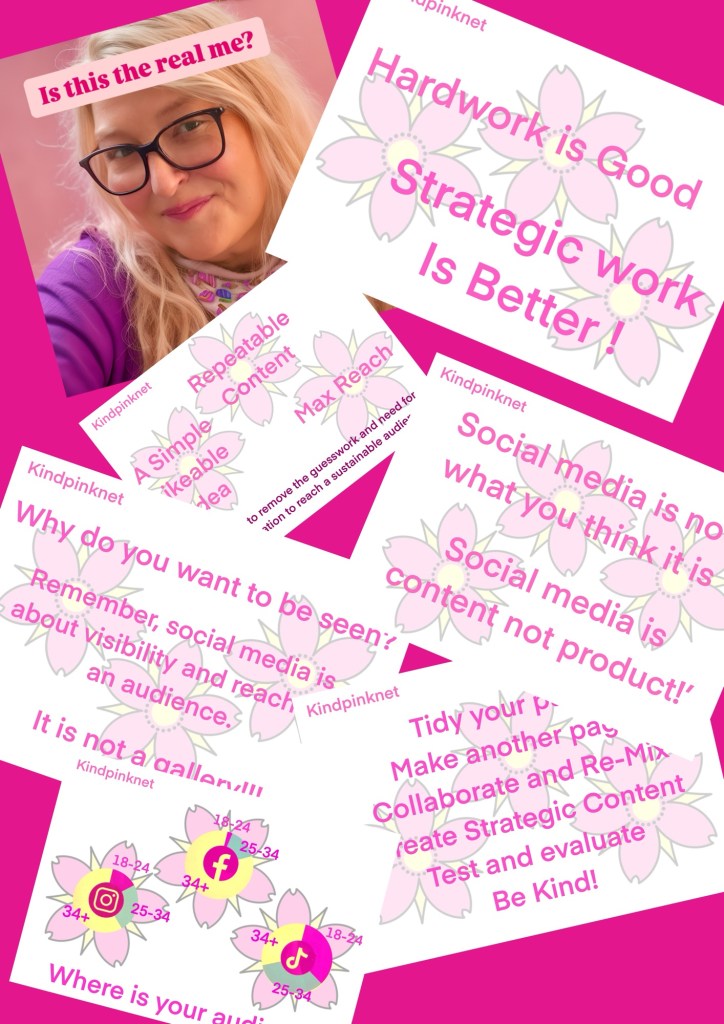
I ran a social media workshop looking at strategic approaches to social media for creatives on Saturday, the 12th of April; it was about democratising knowledge.
I have begun to see my art practice has to acknowledge and respond to all forms of interlocking oppression within my own lived experience, and that includes ageism.
Knowledge is power, and new technology is often seen as a product of youth. I don’t think that’s true. Instead, technology is in the hands of the ‘tech bros’ but targets youth. To redress the inequities continued education for all should be the goal.
The stereotype is familiar: a 20-something in a hoodie, hunched over a MacBook, ruling the world from a San Francisco coffee shop. It’s the image Silicon Valley loves to project. But like most stereotypes, it’s both misleading and harmful.
We’ve been sold the narrative that technology is youth. Fresh faces, fresh ideas—that’s the formula for innovation, right? Not quite. The reality is far more nuanced…
We often miss that while young entrepreneurs grab headlines, the tech industry’s backbone is built on decades of accumulated knowledge and, crucially, wealth. It is about nations, stock markets and heteronormative power structures. (Archibugi, Vitantonio Mariella, and Antonio Vezzani, 2025)
The ‘tech bros’ are old! They control the narrative to maintain the illusion of opportunity for youth to perpetuate a system.
What the ‘tech bros’ do is stand on the shoulders of generations who came before them. The first computer programmers to capitalise and develop technology as a frontier were black women in their 40s and 50s working for NASA in the 1960s (Shetterly, 2016).
What’s really happening is something more complex. Tech isn’t a product of youth; it’s a product of knowledge, experience, and the audacity and confidence to question established norms. Young people aren’t creating technology so much as they’re being shaped, influenced, and sometimes constrained by it.
But there’s a deeper problem here. While tech bros dominate boardrooms and venture capital investments, millions of young and older people are left out of the digital revolution. The solution isn’t to perpetuate the myth that innovation belongs to the young. Instead, we need to democratise knowledge itself.
This is where shared knowledge becomes critical—not just coding boot camps or traditional degrees, but a fundamental rethinking of how we approach learning throughout our lives. Technology moves too fast for one-and-done education. We need grass-roots systems that encourage a continued quest for knowledge.
Five minutes into Saturday’s workshop, a participant said, ‘I’ve got to go. I can’t do this; my brain doesn’t work that fast.’ We encouraged her to stay. By the end, she said, ‘I’m going to be a social media influencer! ‘ That was a huge positive moment for us all!
Making knowledge accessible to everyone, regardless of age, background, or circumstances, empowers us all.
Knowledge transfer works for all demographics. I see young people who are scared to talk to each other and engage with the world outside their smartphones.
Imagine a world where a 60-year-old can pivot to cybersecurity without raising eyebrows and where a teenager can learn from seasoned engineers without feeling intimidated. Where knowledge flows freely across generations, unencumbered by artificial barriers of age or status.
The truth is that innovation doesn’t have an age limit, and knowledge doesn’t expire. What matters is creating environments where everyone can learn, contribute, and grow. The next big technological breakthrough might come from a teenager in Tokyo or a retiree in Rotherham, but only if we give everyone the tools and opportunities to participate.
The tech industry’s youth propaganda isn’t just inaccurate; it’s counterproductive. Real progress comes from accessibility, combining the energy of youth with the wisdom of experience. To do that, we must build bridges across generational divides and embrace a more inclusive vision of innovation.
For the world to change (and it needs to change, or it will die), we can’t afford to leave anyone behind.
The future is about access.
Archibugi, D., a, Vitantonio Mariella, and Antonio Vezzani (2025) What next? Nations in the technological race through the 2030, Technological Forecasting & Social Change.
Shetterly, M.L. (2016) Hidden Figures: The American Dream and the untold story of the Black women mathematicians who helped win the space Race.
 Mx.D.P
Leave a comment