
Caravaggio’s Death of the Virgin (1601–1606) queered the established religious history painting conventions. It subverted, interrogated, and destabilised normative frameworks and birthed alternative perspectives.
Caravaggio exposed the artificiality of religious painting. He made a deliberate and radical departure from the Catholic conventions that had seen the Virgin Mary as ascending into heaven not bodily dying.
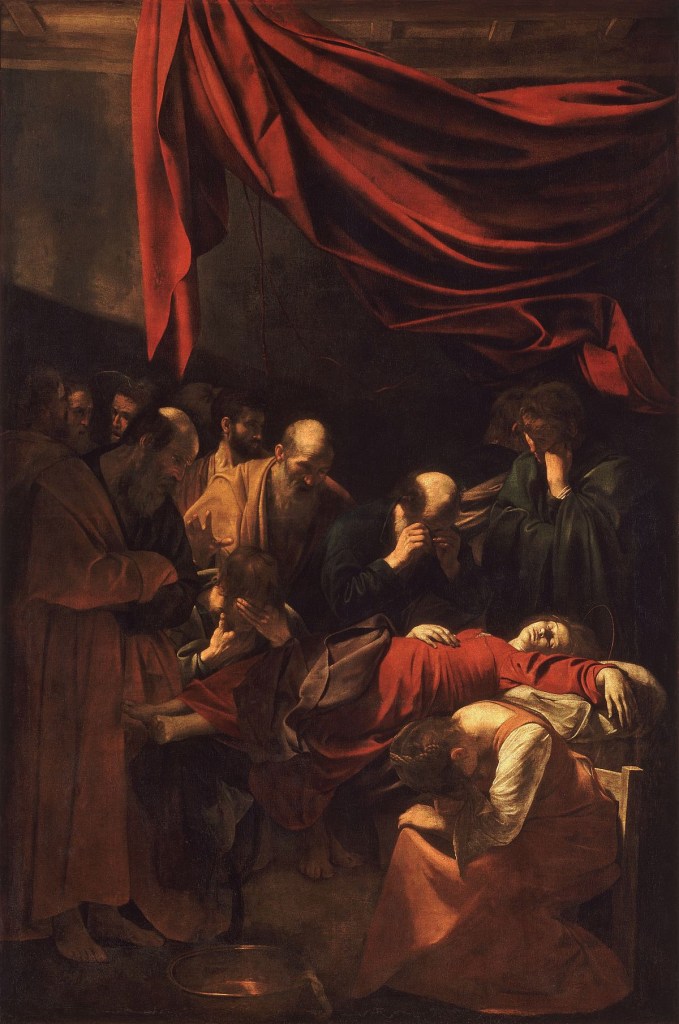
Traditional representations of the Dormition or Assumption of the Virgin Mary sees her passing in a transcendent experience. She is often depicted as serene, radiant, and untouched by the indignities of physical death. The Virgin Mary’s sanctity was usually marked by an celestial idealised corporeality. Her attending apostles were, likewise, presented as dignified, composed, and spiritually uplifted. Such images reinforce an unbridgeable gulf between the sacred and the mundane, between the divine and the human.
Caravaggio’s painting, queered this normative in his adherence to the truth of death. Mary wears a contemporary red dress. Her body is rendered with unflinching naturalism. She lies lifeless on a simple bed, her form swollen and grey, her bare feet exposed to the viewer in a manner that was widely considered sacrilegious. Contemporary accounts suggest Caravaggio used the corpse of a drowned prostitute as his model, an act which further heightened the painting’s transgressive aura.
This radical humanisation of Mary constitutes a profound queering of the subject, as it disrupted the visual and theological binaries. Rather than an ethereal, untouchable vessel of the divine, Mary is subject to the same corporeal vulnerabilities as any of us. The painting’s psychological register is equally subversive. The apostles and Mary Magdalene, gathered around the Virgin’s body, are depicted not as paragons of spiritual composure, but as ordinary people overwhelmed by grief and confusion. Their responses are individual, raw, and palpably human, collapsing the distance between the viewer and Mary’s death.
Caravaggio’s approach destabilises the relationship between artist, institution, and audience. The painting was famously rejected by the nuns that commissioned it, on the grounds of its improprietous blasphemy. This very act of rejection gives a tacit understanding of the challenge to ecclesiastical authority and the prescriptive boundaries of religious art. This work embraces the physical, emotional, and social realities that traditional iconography sought to sublimate or deny. Caravaggio’s Death of the Virgin not only queers the subject matter, but also queers the broader discourse surrounding sanctity, representation, and power.
 Mx.D.P
Leave a comment