
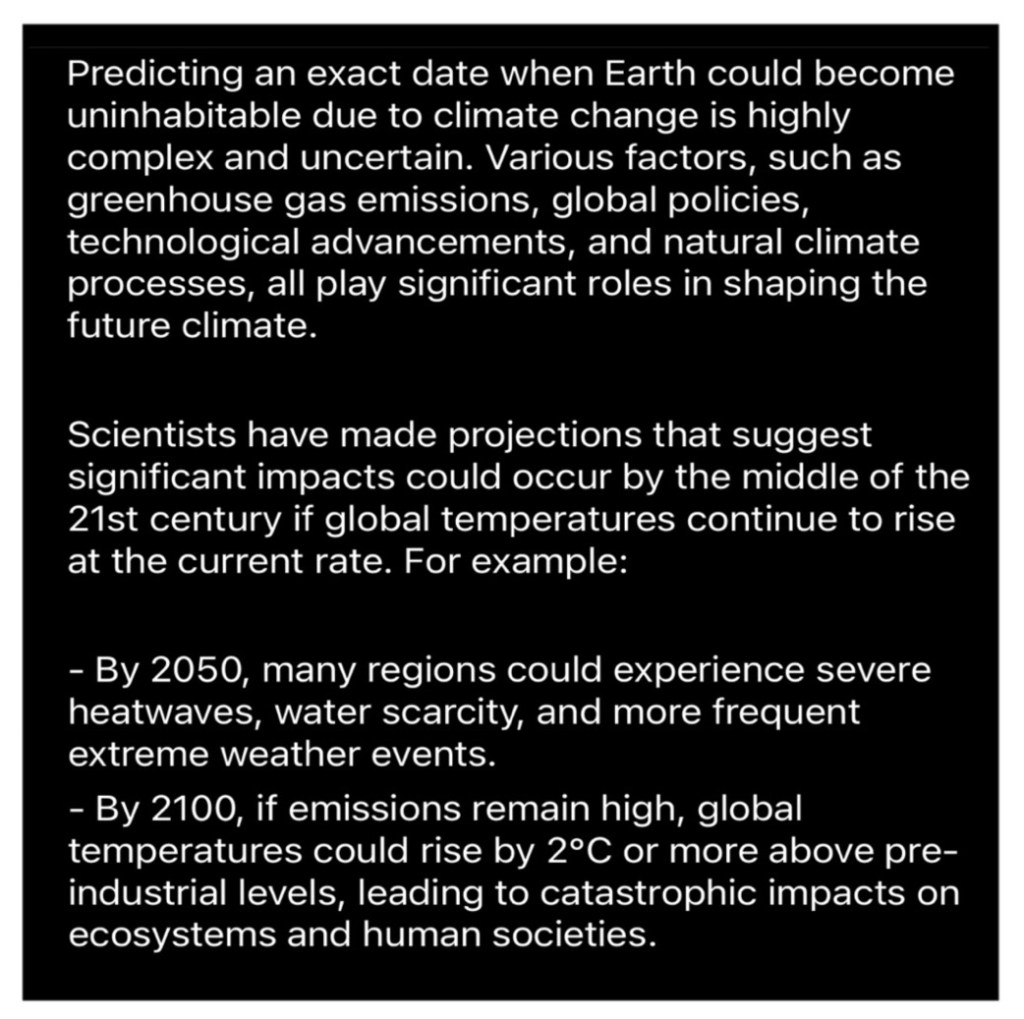
ChatBox is a 2023 trained AI model, so this could be an AI hallucination, but I rather think it isn’t.
Current estimates suggest warming of 3.6°C is more likely as climate policies are being stalled or reversed. The IPCC also outlines a worst-case scenario where global temperature could rise by 4.4°C by 2100 if fossil fuel use increases dramatically and no strong mitigation is adopted.
If global temperatures rise by 4.4°C above pre-industrial levels the consequences would be extreme and catastrophic for much of life on Earth, not just humans. Here’s what the latest science says, BRACE YOURSELF
Extreme Heat and Unliveable Regions
Unprecedented Heatwaves: Huge parts of the tropics, Middle East, South Asia, and some temperate regions could experience wet bulb temperatures (a measure combining heat and humidity) that are lethal to humans without air conditioning, even for healthy people sitting in the shade.
Chronic Heat Stress: Billions of people would face dangerous heat for weeks or months each year. Outdoor work would become impossible in many regions.
Massive Sea Level Rise
Projections: Sea levels could rise by 0.5 to 1 meter by 2100, with several meters more locked in and irreversible over coming centuries as polar ice melts.
Coastal Cities: Major cities (London, New York, Shanghai, Mumbai, Lagos, Miami, etc.) and whole low-lying countries could become uninhabitable or lost to the sea, displacing hundreds of millions.
Collapse of Food and Water Systems
Crop Failures: Staple crops would fail in much of the world, with global yields falling by up to 50% in some regions. Some areas could see near-total loss of agricultural viability.
Water Scarcity: Severe, permanent droughts would affect huge swathes of the planet, leaving billions without reliable water.
Ecosystem and Biodiversity Collapse
Mass Extinctions: Most coral reefs would vanish, rainforests could collapse, and up to half or more of all plant and animal species could face extinction.
Ocean Life: Widespread oxygen loss, acidification, and warming would decimate fish stocks and marine ecosystems.
Health and Social Chaos
Health Crises: Massive increases in heat-related deaths, malnutrition, disease outbreaks, and air pollution.
Migration and Conflict: Displacement of up to a billion people, widespread famine, and soaring risk of conflict over food, water, and land.
Economic Meltdown
Global Economy: Economic damages could exceed 10–20% of global GDP. Insurance, banking, and government systems could collapse in the most affected regions.
What is the bottom line Mx D.P.?
A 4.4°C world is almost unrecognisable compared to today.
Large areas would be literally irreversibly uninhabitable for humans and other species.
Food and water shortages, mass migration, and social breakdown would be the norm. The risks of crossing irreversible tipping points globally, like rapid ice sheet collapse or Amazon rainforest dieback, would be very high, locking in even more warming and impacts for centuries.
This scenario is why even a 3°C world is considered dangerous, and why rapid emissions cuts are so urgent.
So things are really grim folks.
Best go make some Art!
Better still make a kind comunity, you could use Art to do that!
…Good Idea Mx. D.P.
AR6 Synthesis Report: Climate Change 2023 (no date). https://www.ipcc.ch/report/ar6/syr/.
Climate Action Tracker (2024) Warming projections global update, Climate Action Tracker. https://climateactiontracker.org/documents/1277/CAT_2024-11-14_GlobalUpdate_COP29.pdf.
Climate Change 2022: Impacts, adaptation and Vulnerability (no date). https://www.ipcc.ch/report/ar6/wg2/.
Climate change: UN report says planet to warm by 3.1 C without greater action (no date). https://www.reuters.com/business/environment/climate-set-warm-by-31-c-without-greater-action-un-report-warns-2024-10-24/.
Emissions Gap Report 2023 (no date). https://www.unep.org/resources/emissions-gap-report-2023.
Emissions pathways (no date). https://climateactiontracker.org/global/emissions-pathways/.
Forrest, C. (2025) ‘IPCC AR6 outlines five critical future scenarios | Anthesis Group,’ Anthesis, 12 May. https://www.anthesisgroup.com/insights/five-future-scenarios-ar6-ipcc/.
Impacts of a 4°C global warming (no date). https://www.greenfacts.org/en/impacts-global-warming/l-2/index.htm.
Pörtner, H.-O. et al. (2022) Summary for policymakers, Climate Change 2022: Impacts, Adaptation and Vulnerability. Contribution of Working Group II to the Sixth Assessment Report of the Intergovernmental Panel on Climate Change. Edited by A. Alegría et al. Cambridge University Press, pp. 3–33. https://doi.org/10.1017/9781009325844.001.
United Nations Environment Programme (no date) Looking back at the environmental highs – and lows – of 2024. https://www.unep.org/news-and-stories/story/looking-back-environmental-highs-and-lows-2024.
Wong, T. (no date) What Would Cities Look Like With 3 Degrees C of Warming vs. 1.5? Far More Hazardous and Vastly Unequal. https://www.wri.org/insights/climate-change-effects-cities-15-vs-3-degrees-C.
 Mx.D.P
Leave a comment